Curriculum Notes Year 9
A warm welcome back to Cranmore, and a heartfelt greeting to our new pupils and families. Year 9 is a pivotal year, full of opportunities to explore subjects, develop lifelong skills, and begin thinking about future pathways; we are particularly excited that your son will be preparing to make their GCSE choices in the New Year.
This year, pupils will have the chance to dive deeper into their favourite subjects, discover new interests, and challenge themselves in all aspects of school life. Our dedicated team of teachers and staff are here to support and guide them every step of the way, ensuring that they feel confident and prepared for the challenges ahead. As always, we aim to offer ample opportunities for character development, maturity, resilience, and leadership skills. Finally, the curriculum below offers an insight into the subjects your son will engage with over the course of this year.
We look forward to working together to make Year 9 a year of growth, discovery and success.
Should you have any questions, the tutor team comprises of Mr Jones, Mr Rahman and me.
Please do not hesitate to contact us should the need arise.
Mr Marcus Chapman
Head of Year 9
marcus.chapman@cranmore.org
miz.rahman@cranmore.org
theo.jones@cranmore.org
English
Head of Department: Mr Marcus Chapman
In Year 9 we are preparing thoroughly for the skills and knowledge required to transition to KS4 with confidence. The teaching groups will be setted.
In the final year of Key Stage 3, Year 9 pupils will continue their study of dystopian fiction: Set 1 will read Fahrenheit 451 by Ray Bradbury and the other sets will read The Hunger Games by Suzanne Collins. They will then read and study Journey’s End by R.C. Sherriff, a play that portrays the experiences of soldiers in the trenches of the First World War. In the summer term, pupils will begin their English GCSE studies in earnest as we read and deconstruct An Inspector Calls by J.B. Priestley.
Language study will be interwoven during each unit and will emphasise clear planning; accuracy of spelling and punctuation; proofreading; developing vocabulary and improving style. A range of writing purposes will be explored, including persuasive, descriptive, explanatory, and review. Pupils will write for different forms and audiences that will be assessed at GCSE, varying register and tone as appropriate.
Advanced analytical and evaluative writing forms a central part of learning this year and pupils will be expected to respond analytically to unseen extracts, textual passages and write whole texts essays about authors’ methods and intentions.
Speaking and listening skills will be developed through class discussion, hot-seating and book presentations and debating and drama performance.
There continues to be an expectation that all pupils will read widely throughout the course and will stretch themselves to tackle texts they find more challenging. They should talk about their reading with an adult at least once each week to discuss and extend their comprehension.
Pupils will be assessed formatively in class every lesson via questioning, teaching marking, self and peer assessment. In addition to the January and May assessments, pupils will be assessed in class every half term.
Each week there will be two homeworks which should take approximately 30 minutes each. One may be a reading homework that relates that relates to the text being studied. Pupils will have a fortnightly 30-minute library lesson where they are able to select books, discuss their reading, complete research tasks and survey the reading list.
Mathematics
Head of Department: Mr Christopher Savvides
Mathematics is fundamental to many areas of our lives, and it is therefore crucial that we equip our children with the necessary skills to become confident, logical and resilient problem solvers as they embark on their journey to adulthood.
We believe that Mathematics should be engaging, challenging, practical and interactive. We make the most of Mathematics challenges and team competitions to encourage participation and ensure our children are enthusiastic and motivated mathematicians. We endeavour to utilise various methods and techniques across the curriculum and instil a love for mathematics into each pupil.
In Year 9, all students follow the same scheme of work for Mathematics, which is based on an enhanced National Curriculum, with a focus on problem solving, mastery and fluency.
Year 9: Programme of Study
Number: Standard form, indices, estimation, errors and bounds. Fractions and percentages, surds.
Algebra: Multiplying brackets, inequalities, graphs, simultaneous equations, formulae, quadratic equations.
Shape, space and measure: Trigonometry, Similarity, 3D shapes, circles and cylinders, Transformations.
Data Handling: Interpreting data, Averages, Representing data, tree diagrams
Resources
Pupils use the Essential Maths series of textbooks published by Elmwood Press. We have carefully mapped our curriculum on https://www.drfrost.org so that pupils have access to a vast library of appropriate problems for consolidation. Pupils and teachers also use https://www.mathspad.co.uk/ as an excellent resource to further develop understanding of topics. Our VLE pages contain lots of information, links and resources to support your son with their learning and progress.
There are a wide range of hugely impactful interactive resources available to us online and the quality of these resources have increased hugely over recent years. As a department we are constantly sharing what works best and we keep on top of innovative resources and approaches to teaching Mathematics.
In addition to our classroom provision, pupils also have access to our drop-in support session, MathsLink, which takes place on Friday lunchtime, and our Maths Challenge club, which takes place on a Thursday after school.
Science
Head of Department: Mr Stuart Minikin
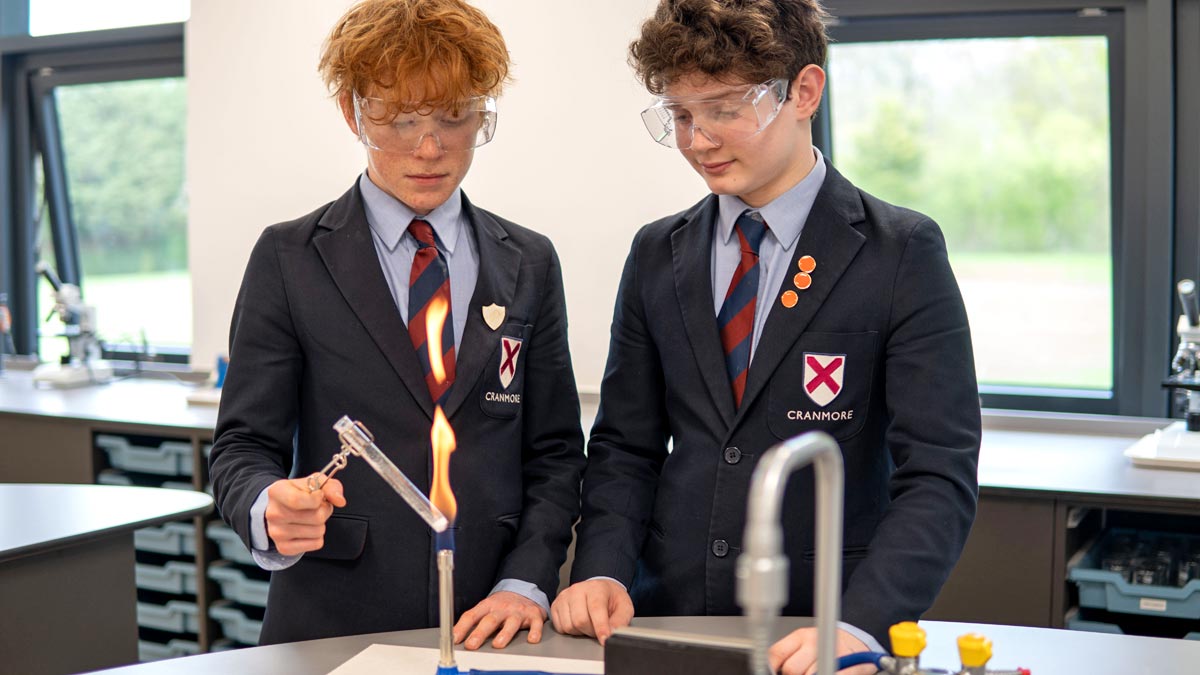
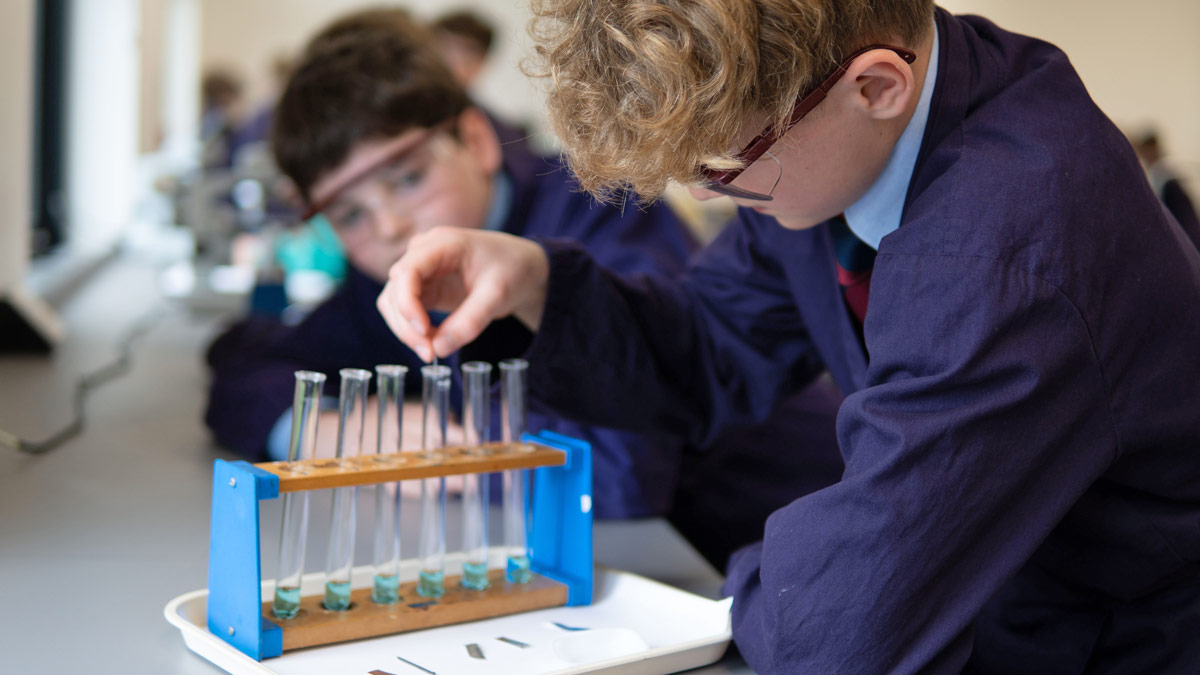
At Cranmore our aim is to develop scientists with a rigorous understanding of the subject, an enthusiasm for learning and the confidence to question, evaluate and articulate their ideas. We encourage all students to develop a love for science by balancing theory with practical work and place a high value on developing the technical and analytical skills needed to investigate experimentally. We create a safe environment in which the students feel comfortable exploring their understanding and where we can add to both their knowledge and skills. We focus on developing a meticulous approach to practical investigations which are used as often as possible, to support the learning of theory. Our s
YEAR 9: Programme of Study
Biology
- Cells and Microscopy
- Cell Division and Transport
- Plant and Animal Tissues and Organs
- The Heart and Circulatory System
Chemistry
- Atoms, Elements and Compounds
- The Periodic Table
- Bonding and Properties of Matter
- Molecules and Giant Structures
Physics
- Energy Stores and Systems
- Conservation of Energy
- Work Done and Power
- Specific Heat Capacity
Resources & Information
Science is taught by specialist teachers and pupils will be assessed regularly, usually at the end of each topic, to support their progress. The Science Department enjoys the use of large laboratories and two prep rooms which are well provisioned for the learning of the science curriculum. Our Science Technician ensures the preparation of the equipment for practical activities and supports the teaching staff on a daily basis. Additional resources, together with details of homework, can be found on the VLE.
Languages
Head of Department: Mr Theo Jones
Our philosophy as a department is to inspire and motivate the pupils by giving them a positive, lively and enjoyable experience of foreign language learning. We especially strive to acknowledge the individuality of every pupil with his unique talents. We aim to help all children to become confident on their journey of linguistic discovery, improving their own skills and developing them steadily to their full potential. For this to be achieved, our pupils must naturally have a positive attitude to the subject, and we see it as part of our task to foster such an attitude.
Resources & Information
For all 3 language subjects, the pupils will have weekly vocabulary tests and end of topic assessments throughout the year and an end of year exam in May, assessing productive skills.
The pupils will have access to a variety of resources and material including https://activehub.pearson.com, www.languagesonline.com, and www.conjuguemos.com. Additional resources are available on the VLE and students are provided with a vocabulary booklet.
Homework is once a week for each language and consists of vocabulary learning and interactive tasks to reinforce what has been taught in the lessons. From time to time, they will also complete writing tasks and fun cultural activities.
French
In French, pupils will study AQA GCSE (2024) French Foundation modules 1-3. They will revise the perfect, immediate future and present regular and irregular tenses across a variety of topics. Pupils will continue to develop their reading, listening, speaking, writing and translation skills.
Year 9: Programme of Study
Module 1
Topics & Vocabulary
- Francophone world
- Online activities
- Staying active
- Films and television
- Making plans to go out
- Last weekend
- Sports
Grammar
- aimer + noun / aimer + infinitive
- Present tense ER verbs
- Present tense irregular verbs
- Answering questions
- Near future tense
- Perfect tense
Module 2
Topics & Vocabulary
- Your identity
- Weekend routine
- Friends and friendships
- Favourite celebrity
- Positive role models
- Celebrations
Grammar
Questions in the perfect tense and using two tenses together
- Emphatic pronouns
- Reflexive verbs in the present tense
- Adjective agreements
- Adjective position
- Direct object pronouns
- Perfect, present and future tense
Module 3
Topics & Vocabulary
- School in francophone countries
- School subjects and life
- School rules
- Making progress
Grammar
- Describing photos
- Comparative adjectives
- Impersonal verbs with infinitives
- Irregular verbs in the perfect tense
Spanish
In Spanish, pupils will study AQA GCSE (2024) Spanish Foundation modules 1-3. They will revise the preterite, immediate future, and present regular and irregular tenses across a variety of topics. Pupils will continue to develop their reading, listening, speaking, writing, and translation skills.
Year 9: Programme of Study
Module 1
Topics & Vocabulary
- Spanish-speaking sports stars
- Life online
- Sports and free-time activities
- Arranging to go out
- Saying what you did at the weekend
- Talking about days that went wrong
Grammar
- Adjectives
- Revising present tense
- Expressions of frequency
- Irregular present tense verbs
- Opinion verbs and expressions
- Near future tense
- Preterite tense
- Using three tenses
- Direct object pronouns
Module 2
Topics & Vocabulary
- Describing a photo
- Travel plans
- Festivals in the Spanish-speaking world
- Saying what you did on holiday
- Describing where you stayed
- Describing holidays using different tenses
Grammar
- Me gusta(n) / Me gustaría + infinitive
- Using comparatives
- Se puede(n) + infinitive
- Superlatives
- If clauses with the present tense
- Acabar de + infinitive
- Opinions in the past
- Imperfect tense
- Positive and negative opinions
- Suelo + infinitive
Module 3
Topics & Vocabulary
- Different families
- Describing people
- Your favourite celebrities
- Friendships and relationships
- Your identity and what matters to you
- Problems and advice
- Family celebrations
Grammar
- Possessive adjectives
- Present continuous to describe a photo
- Ser and estar
- Using the personal ‘a’
- Reflexive verbs
- Me and te before a verb
- Para + infinitive
- Podrías /Deberías + infinitive
- Indirect object pronouns
- Using a range of preterite tense verb forms
Latin
Latin will be learnt using De Romanis Book 1 Chapters 3 to 5 with online activities, as well as reading comprehensions, and translation activities. The pupils will have access to www.clc.cambridgescp.com, www.conjuguemos.com, and www.languagesonline.org. We encourage the use of these resources at home and in school.
Year 9: Programme of Study
Grammar:
- Nouns: nominative and accusative
- Nouns: case endings and declensions
- Nouns: three genders
- Adjectives: nominative and accusative
- Adjectives: singular and plural endings
- Prepositions
- The ablative case
- Infinitives and conjugations
- Irregular verbs
- Imperfect tense
- Adverbs
- Direct questions
- Genitive & dative
- Present tense: sum, possom, eo
- Derivations and parts of speech
Vocabulary:
- Around 15-20 words per chapter which are also on the GCSE vocabulary list.
- Derivation work to make connections between Latin vocabulary and English, French and
Spanish vocabulary.
Culture:
- Translation from Latin to English exploring the culture and history.
- The Ludi Romani
- Spartcus
- Gladiator show
- Charioteer
Religious Education
Head of Department: Mr Graham West
Overview
Religious Education at Cranmore is a subject that enriches all pupils. It helps pupils to develop their understanding of religion and to reflect on their own identity and the world in which they live. In Year 9, Pupils deepen their understanding of the Catholic story of salvation by exploring key themes such as human dignity, ethical issues surrounding life, devotion to Mary, and the call to discipleship, examining how these beliefs shape moral decision-making and lived faith. All topics covered in RE follow the Religious Education Curriculum Directory for Catholic Schools.
Year 9 will cover the following topics this year
Creation & Covenant
Pupils explore the Genesis creation stories, focusing on imago Dei, human dignity and the sanctity of life, and consider how these beliefs inform moral choices and a variety of ethical issues.
Prophecy & Promise
Pupils study how God’s plan for salvation unfolds through key figures, especially Mary, exploring faith, humility and the fulfilment of God’s promises in Scripture.
Galilee to Jerusalem
Pupils investigate discipleship through the Gospel of Mark, including teachings such as the Rich Young Man and the role of women in Jesus’ ministry. They explore vocation and religious life.
Desert to Garden
Pupils examine themes of sacrifice, atonement and redemption, linking Old Testament practices with Jesus’ sacrifice and the New Covenant.
To the Ends of the Earth
Pupils explore the development of the early Church and Catholic beliefs about the Church on earth, in heaven and purgatory.
Dialogue & Encounter
Pupils consider the Church’s role in the modern world, focusing on social justice and the common good. They also engage in dialogue with other worldviews, including an introduction to Hinduism.
Resources & Information
In Religious Education pupils will develop a good understanding of the key components of Catholic Christianity and be exposed to various religious questions. Through a variety of activities, pupils are asked to consider different perspectives and consider their own personal responses to theological and ethical challenges. We use the Source to Summit textbooks and the VLE is used for extension and revision material.
History
Head of Department: Mr Rhys Cross
In Year 9 we start by briefly analysing the process of how universal suffrage was won in Britain in the 19th and early 20th century, with a particular emphasis on how women fought for the right to vote. However, our main focus for this year will be 20th century warfare in Europe. This will include the study of the following topics.
Year 9: Programme of Study
- Causes and build up to the First World War
- Trench warfare and the war at home
- The Interwar Period – Introduction to Communism and Fascism as ideological concepts
- The Second World War – Key events include Dunkirk, Battle of Britain, D-Day Invasion. A case
study of a battle on the eastern front also will be incorporated
Our principal objective by the end of the teaching year will be to reach 1945, having studied both world wars in great depth. However, if time allows, we will proceed to develop a broad understanding of how the Cold War came into existent. Key topics will include Yalta and Potsdam Conferences (1945), The Iron Curtain Speech (1946), Truman Doctrine (1947) and The Marshal Plan (1948).
Resources and Information
The emphasis will be very much on the dual disciplines of essay writing and source analysis skills, as these are the skills required to succeed at GCSE History.
The students will study the same period of History covered for a portion of their GCSE course; however, Year 9 gives a detailed introduction to major conflicts and concepts, and therefore provides the student will a foundational understanding of potential GCSE topics. Whereas at GCSE level the students will select a single topic, for example, ‘Nazi Germany 1919-45′, and investigate the topic in greater depth. Therefore, this academic year enables them to begin their GCSE course (the following year) with a sound grasp of the topic and concepts involved. The same analytical skills learnt at Key Stage 3 History apply to the historical sources tackled at GCSE level, but the calibre of response will be expected to be higher.
The History Department is fortunate to be well provisioned. Relevant digital clips, up to date textbooks designed specifically for GCSE preparation, bespoke PowerPoints and various worksheets will all be utilised in the learning process, as well as personal devices. Information pertaining to many of the topics covered can be found on the VLE.
Geography
Head of Department: Mr Mark Spalton
In Year 9 we revisit the geographical content of prior topics studied across key stage 3 and apply these to the continents of Asia and the Americas. The syllabus aims to encourage pupils to use a range of geographical skills to develop their understanding of how the physical landscape and the human environment interact within areas of the globe today. The main emphasis of this year is for students to apply their knowledge to new locations to consolidate their geographical understanding ready for the all-important GCSE option choice decisions.
- Asia – the physical landscape
— Climate, ecosystems and the Malaysian Rainforest
— The Himalayas and the Nepal Earthquake
— Floods & Droughts: The monsoon and the Gobi Desert
- Asia – the human environment
— Demographics – The impacts of population policies
— Energy – Hydroelectric Power in China
— Sustainable Cities – Singapore
- The Americas – the physical landscape
— North American Glaciers and climate change
— Tornadoes
— Volcanic activity – Volcan de Fuego vs Mt Kilauea
— The Colorado River – journey from source to mouth
- The Americas – the human environment
— Deforestation, debt reduction and conservation – Guatemala vs Belize
— Migration through Central America – narconomics and the USA boarder
— Trade and the Panama Canal
- UK Landscapes
— Rivers – formation of landforms through erosion and deposition, flood management
— Coasts – formation of erosional and depositional landforms, coastal management
Resources and Information
The focus will be on developing both analytical skills from which to gather information and the ability to write logical concise responses making use of appropriate evidence to support their reasoned answer. The syllabus will give them a wider understanding of key regions of the world and issues facing the planet. Assessment will be ongoing with regular small assessments and examination in the spring and summer terms. The VLE, resources on Teams, along with their associated textbooks provide a good range of resources from which to develop their understanding. It is important to stay up to date with current events in the media to give real world examples of topics learnt throughout the year.
Computing
Head of Department: Mr Ahmed Afana
In computing, the goal is to provide a high-quality digital education that equips students with computational thinking skills and empowers them to use technology wisely and safely. With a 1:1 device program, we aim to foster creativity and research opportunities in various subjects. In this year’s units, pupils will learn GCSE topics to give them an idea of the GCSE Computer Science option. Each unit has links to previous learning and future issues if they choose the subjects as one of their GCSE options.
The computing curriculum includes these interrelated elements:
- Computer Science (CS): is the discipline that explains how digital systems work, how they are designed and programmed, and the fundamental principles of information and computation.
- Information Technology (IT) covers the purposeful creation and application of digital systems to communicate, transfer data and process information collaboratively.
- Digital Literacy (DL) is the ability to access, use, and express oneself using digital technology responsibly and safely, including a critical understanding of technology’s impact on the individual and society.
Programme of Study:
- Introduction to cybersecurity
- Python programming with sequences of data
- Experience AI (Artificial Intelligence)
- IT: iDEA Award
Assessment:
Students will be assessed for each unit through either online fact recall or project-based assessments.
Resources and information:
Throughout the year, students will use various platforms as part of the physical computing approach. This includes Raspberry Pi devices, BBC Micro: bit, MS 365 Teams, and Educake for homework and assessments. They will document their learning on OneNote and receive a knowledge organizer for each unit, containing essential facts and keywords. Assessments will be conducted periodically and at the conclusion of each unit.
Design & Technology
Head of Department: Mr Chris McGhee
Overview
In Design and Technology, pupils will learn about how to become effective designers. There will be an initial focus on introducing the necessary traditional sketching skills which is an important tool in any designer’s kit and a key skill if looking to progress onto GCSE.
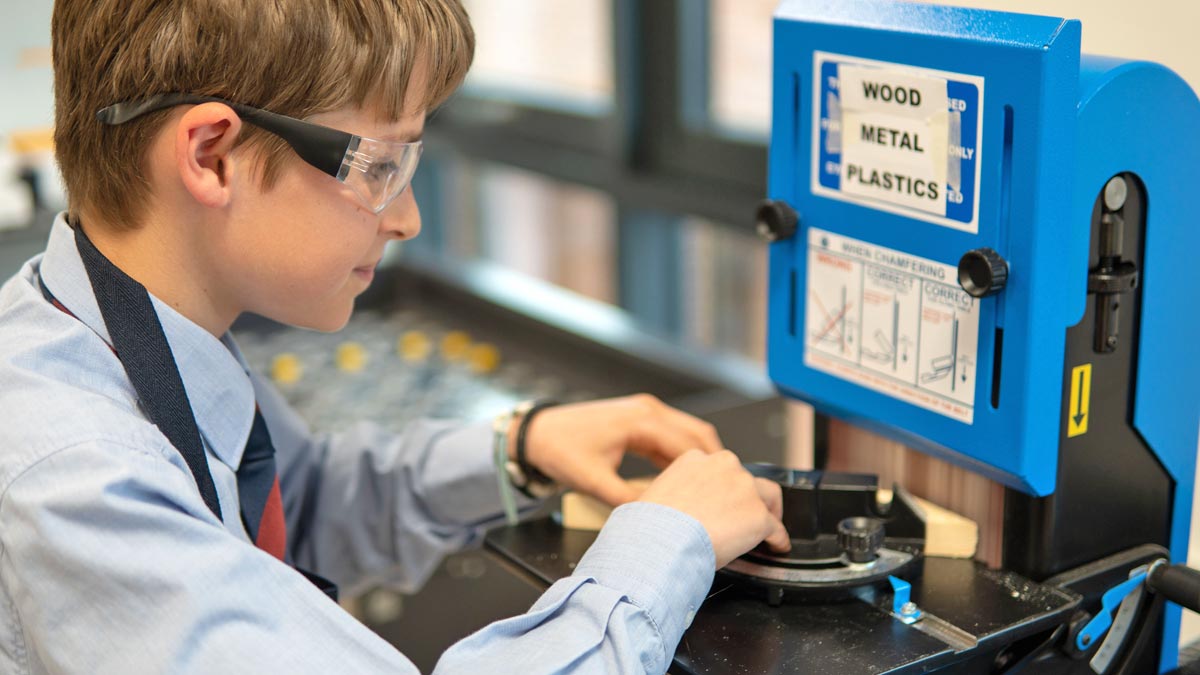
Pupils will then develop practical skills and a safe understanding of how to use the machinery available to them. Pupils will gain experience of using tools and machinery in the workshop to carry out several focused design and make tasks.
The emphasis of the course is on building independence and creativity.
Year 9: Programme of Study
- Health and Safety.
- Tool and machine confidence.
- CAD/CAM.
- ‘Season’ themed projects working in a variety of different materials.
- Collaboration and teamwork
Drama
Head of Department: Mr Thomas Penfold
With an important year ahead, Drama seeks to give pupils a taster of GCSE Drama this year. Focusing on a wide range of practitioners and skills that will be integral to the GCSE course. Pupils will get a sense of the level of creative autonomy required to achieve in this subject as well as a wealth of knowledge to support their creative efforts.
Pupils will also be introduced to a variety of roles and responsibilities within the world of the theatre and be given an opportunity to try their hand at roles such as, Lighting, set and sound design, play writing, costume and direction. This year will culminate with a devised Drama performance that will showcase their talents, created by their own inspiration and research and will give them the perfect snapshot of what to expect if they were to select Drama at GCSE level.
Year 9 Programme of Study
- Theatre Roles & Responsibilities: Texts in Practice – Focusing on a variety of roles that influence all aspects of performance in combination with a given text. Students will have the opportunity to enact these roles.
- Oracy and Presentation Workshop and Skills – a topic focused around the skills of public speaking, presentation and confident story telling. Designed to give our students the skills required to address an audience. Pupils will explore pace, diction, volume, language, among other skills to develop their public speaking ability. This culminates in a presentation in which students give a presentation in which these skills are assessed.
- Practitioner Study: Konstantin Stanislavski’s Naturalism – exploring the techniques and performance style of theatre’s most influential practitioner. Practicing the magic if, suspension of disbelief, unit and objectives, method acting and emotion recall.
- Monologues and Duologues – Page to Stage exploration – using the skills developed over the year, students will work in small groups to stage scripted performances. Utilising the roles of a performance to bring a script to life.
- Physical Theatre – a study of the performance style. Looking at alternate ways to give our audiences meaning. Through the skills of bodies and objects, symbolism and sequenced movement students will explore how some messages can be effectively presented without normal methods.
- Devising Theatre – Using the skills gained this year, students will create a performance based on a dramatic stimulus. Students have the freedom to present their ideas creatively and in collaboration with their peers.
Resources & Information
In addition to the weekly lesson, we will provide opportunities to attend live theatre performances and to develop skills as informed and thoughtful audience members. Private lessons are available, with the opportunity to take LAMDA exams, and all pupils are encouraged to participate in the senior production.
Music
Head of Department: Mr Richard Harris
General Overview
We aim to develop a ‘love of music’ at Cranmore. With your support, we will inspire the pupils to greater musical heights and encourage them to participate in one or more of the many instrumental and choral groups available to them.
Curriculum Overview
Pupils in this year group enjoy one hour-long lesson each week. The topics chosen for study are designed to keep all pupils engaged in Music and focus on knowledge acquisition, performance, and composition.
Topics include:
- ‘All That Jazz’ – an exploration of Blues and composing a Blues composition using MuseScore
- Dance Music – an exploration of dance music from around the globe and composing an Argentinian Tango composition using MuseScore
- Disco Music – learning about this popular style of music and constructing and performing 7th chords
- Iconic Pop Songs – a listening analysis of five of the most famous songs of this genre
Pupils will be expected to read and play notation, recognise, and identify the sounds of instruments and musical styles. Lessons will often begin with listening tests or rhythm and chord learning.
Performing opportunities for Year 9 musicians are plentiful here at Cranmore: Wednesday assembly, Carol Service, Pupil Concerts, Young Musician of the Year Competition, and the Soiree. The more capable musicians will often perform during Mass.
Resources & Information
During these practical lessons, pupils will often use the extensive range of classroom instruments and the Yamaha keyboards. They will be encouraged to use Musescore 4 software for their composition work.
Assessment in this subject, based on GCSE 1-9 grading, is ongoing throughout the year and is based on their success in listening tests and end of unit assignments. A pupil’s instrumental and / or vocal ability / contribution will also be taken into account. As a rough guide, those pupils wishing to continue their study of Music to GCSE level in Year 10 must have reached a minimum standard of Grade 3 on their instrument by the end of Year 9.
Art & Design
Head of Department: Mrs Felicity Sanders
Overview
The Year 9 curriculum ensures all students continue to develop the refinement of the fundamental elements of Art and Design such as drawing and painting, in addition to building confidence to make independent creative decisions using a range of media and processes. This important creative year will be structured through two themes, starting with the world of animals to refine sculptural processes in Art and Design with sustainable resources. To deepen cultural awareness, students will explore current topics concerning young men in society today, developing more independent artwork. Through more robust research into relevant artists, observational recording and media experimentation, students should be further prepared to understand the range of assessment criteria relevant to GCSE Art and Design.
Artists’ works studied:
Pupils will develop classwork inspired by the cardboard sculptor Josh Gluckstein, using the same material to construct large-scale sculptures of pupil-chosen animals in small groups. To further cultural awareness, pupils will explore the impact of social media icons and a range of contemporary and Renaissance artists addressing male issues such as masculinity, such as Corbin Shaw, Banksy and Michaelangelo. Pupils are invited to source their own critical references independently to build a more personal connection to their own artwork.
Key media processes and techniques explored:
- 3D construction
- Plaster casting/ceramic impressions
- Photography
- Textile applique
- Typography
- Mood-boarding
- Continuous line drawing/observational drawing
- Critical studies in pencil
Further Information and Assessment:
The Art department is well stocked with a creative library of books. Pupils are invited to use free online software such as Photopea to work digitally and record their creative processes in a sketchbook throughout the year.
Pupils can track the development of their skills through their class sketchbook supported by success criteria linked to the GCSE assessment matrix. Homework is undertaken each week to extend their learning and will be posted, when necessary, on the VLE. Pupils can attend a Senior Art Club after school on a Monday as well as homework support one lunchtime a week. Pupils are strongly encouraged to visit Art Galleries to experience real Art up-close, talk about artforms and movements beyond those provided, and contribute personal artwork to the Student Gallery.
Sport
Head of Department: Mr Paul Hodgson
Overview
Within the Sport programme, we continue the ethos of the subject, which is a wide and varied programme to benefit the pastoral well-being, physical health and sporting enjoyment of all pupils.
The aim is to develop the individual core skills for each sport, whilst making sure every pupil fully understands the age relevant rules and laws. Further emphasis is placed on technical and tactical awareness in Year 9, which also allows leadership skills to be developed. Pupils will learn the value of quality practice, training for specific sporting activities and how to follow a process to achieve long-term goals.
Pupils have options which include the following sports:
- Rugby
- Multi-Sports
- Rowing
- Football
- Hockey
- Cricket
Games: Tuesday and Thursday
After-school training: Wednesday
Scholarship Session: Tuesday before school and S&C sessions
Swim Squad: Tuesday after school
Pupils can, if selected, represent the school in the following sports:
- Skiing
- Tennis
- Squash
- Cross-Country
- Athletics
- Golf
- Swimming