Curriculum Notes Year 11
May I extend a very warm welcome back to Cranmore to you and your son. As he reaches this important stage in his educational journey, there is a natural and increased emphasis on academic attainment, ensuring he is well prepared to achieve his full potential in his GCSE examinations.
Whilst it is entirely normal for pupils to experience some apprehension at this point, a clear and purposeful academic focus can, in fact, be highly beneficial. It is often during this phase that pupils see their knowledge deepen, their understanding consolidate, and their confidence grow as they begin to master key concepts across their subjects.
Our Year 11 GCSE programme, whilst appropriately rigorous, has been carefully designed to remain broad, stimulating and engaging. Alongside academic study, there continues to be a strong emphasis on personal development. Pupils are encouraged to build character, resilience and maturity, and to develop leadership skills through a wide range of co-curricular activities, enrichment opportunities and our comprehensive pastoral programme.
We remain committed to supporting your son holistically, ensuring he is both academically successful and personally fulfilled during this important year.
Should you have any questions, the year group team comprises of me, Mrs Bowden, Mrs Reid, Mr. Minikin and Mr Kelly. Please do not hesitate to contact us should the need arise.
Chris McGhee
Head of Year 11
chris.mcghee@cranmore.org
teresa.bowden@cranmore.org
antonella.reid@cranmore.org
stuart.minikin@cranmore.org
ciaran.kelly@cranmore.org
English
Head of Department: Mr Marcus Chapman
English in Year 11 marks the culmination of the pupils’ GCSE English studies. In the Christmas Term, the literature focus will be on Romeo and Juliet, our Shakespearian set text: its plot, characters and themes. We will also prepare pupils for the Unseen Poetry section of their English Literature GCSE. In addition to this, there will be a rigorous English Language GCSE revision programme offering our Year 11 cohort plenty of practice ahead of their mock exams. The latter part of the Christmas Term and the early part of the Easter Term will be dominated by pupils undertaking their mock examinations followed by detailed, individual feedback that will allow each to target his preparation for both English GCSEs. This will be followed by further revision of key areas, including the poems of the Power and Conflict Cluster. We will also prepare the boys for the Non-Examination Assessment of their English Language GCSE.
Year 11: Programme of Study
Christmas Term
AQA Language:
English Language GCSE (Papers 1 and 2) revision
AQA Literature:
Shakespeare set text – Romeo and Juliet; Unseen Poetry preparation
AQA Language and Literature:
first two mock examination papers
Easter Term
AQA Language:
second mock examination and feedback; further targeted revision; Non-Exam Assessment
AQA Literature:
second mock examination and feedback; further targeted revision
Summer Term
AQA Language:
final revision and English Language GCSE: Paper 1 – 24 May 2027; Paper 2 – 8 June 2027
AQA Literature:
final revision and English Literature GCSE: Paper 1 – 12 May 2027; Paper 2 – 19 May 2027
Resources
In addition to their annotated English Literature texts, our Year 11 pupils have workbooks for their English Literature texts to complement their learning in class. A weekly English Catch-up session will be held on Monday lunchtimes for those who wish to attend or whom the English Department feels would benefit from attending. As always, pupils are encouraged to read as widely as possible and the Key Stage 4 Reading List contains a wide range of novels, genres and authors for the pupils to enjoy.
Mathematics
Head of Department: Mr Christopher Savvides
Mathematics is fundamental to many areas of our lives, and it is therefore crucial that we equip our children with the necessary skills to become confident, logical and resilient problem solvers as they embark on their journey to adulthood.
We believe that Mathematics should be engaging, challenging, practical and interactive. We make the most of Maths challenges and team competitions to encourage participation and ensure our children are enthusiastic and motivated mathematicians. We endeavour to utilise various methods and techniques across the curriculum and instil a love for mathematics into each pupil.
In Year 11, students continue on the same Higher scheme of work for Mathematics, which is based on an enhanced National Curriculum, with a focus on problem solving, mastery and fluency. Some of our most able mathematicians also study Extended Mathematics topics alongside our main scheme of work.
Year 11: GCSE Higher Programme of Study
Number and Algebra: Proportionality, Trig graphs, equations of circles, function notation, graph transformations, inequalities, shading regions of graphs, surds, general algebraic proofs.
Shape, space and measure: Vectors, sine and cosine rules, congruence, similarity, proving circle theorems.
Data Handling: Samples and population, histograms, two-way tables, conditional probabilities.
Resources
Pupils use the Rayner GCSE Higher series of textbooks published by Oxford University Press. We have carefully mapped our curriculum on https://www.drfrost.org so that pupils have access to a vast library of appropriate problems for consolidation. Pupils and teachers also use https://www.mathspad.co.uk/ as an excellent resource to further develop understanding of topics. Our VLE pages contain lots of information, links and resources to support your son with their learning and progress.
There are a wide range of hugely impactful interactive resources available to us online and the quality of these resources have increased hugely over recent years. As a department we are constantly sharing what works best and we keep on top of innovative resources and approaches to teaching Mathematics.
In addition to our classroom provision, pupils also have access to our drop-in support session, MathsLink, which takes place on a Friday lunchtime, our GCSE exam practice drop-in session on Tuesday lunchtimes and our Maths Challenge club, which takes place on a Thursday after school.
Science
Head of Department: Mr Stuart Minikin
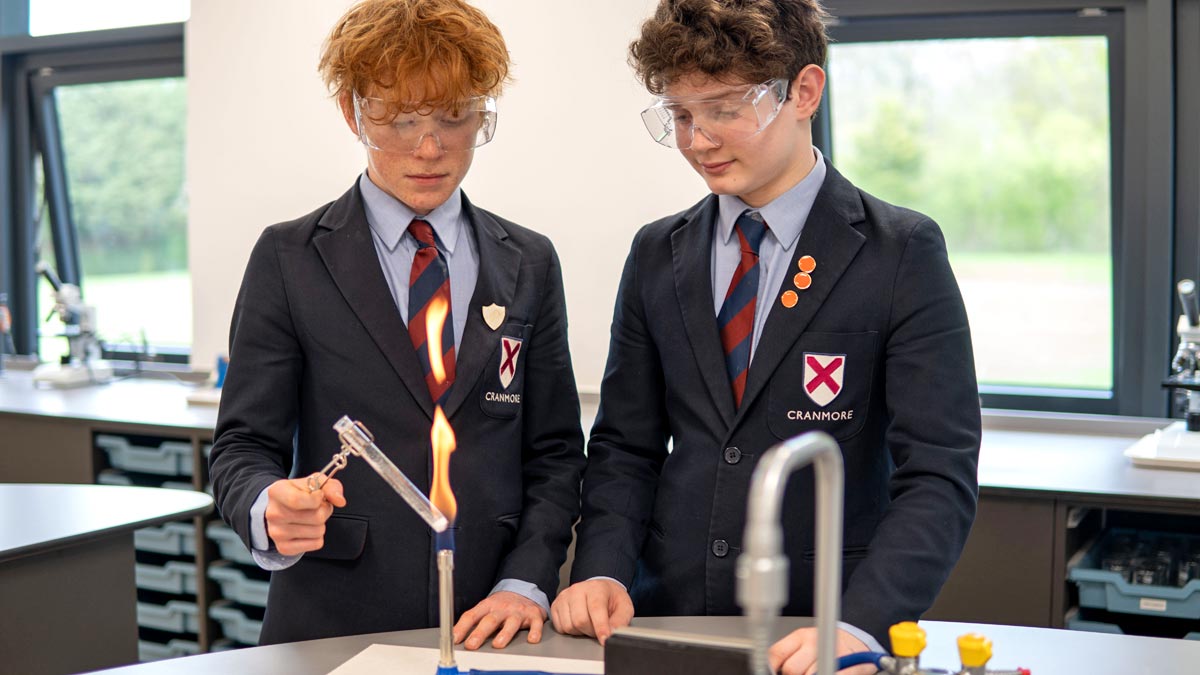
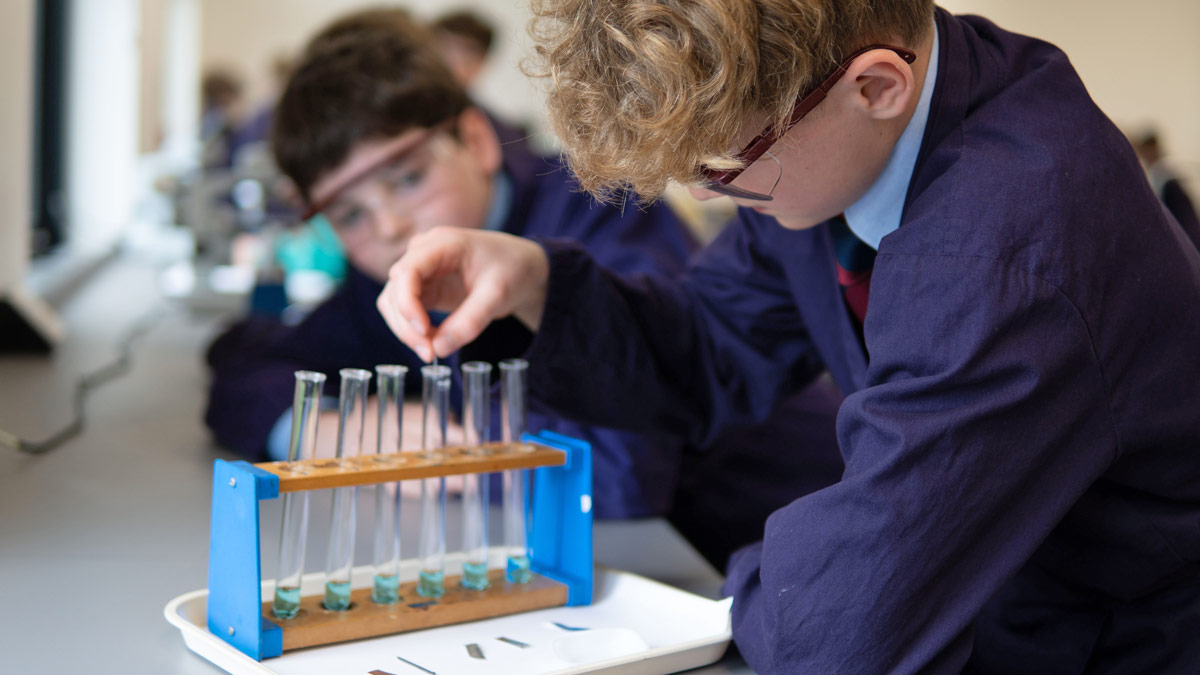
At Cranmore our aim is to develop scientists with a rigorous understanding of the subject, an enthusiasm for learning and the confidence to question, evaluate and articulate their ideas. We encourage all students to develop a love for science by balancing theory with practical work and place a high value on developing the technical and analytical skills needed to investigate experimentally. We create a safe environment in which the students feel comfortable exploring their understanding and where we can add to both their knowledge and skills. We focus on developing a meticulous approach to practical investigations which are used as often as possible, to support the learning of theory. Our students enjoy science and develop techniques that will be useful to them for the rest of their lives.
YEAR 11: Programme of Study
Biology
- Homeostasis and Response
- Inheritance
- Variation and Evolution
- Ecology
Chemistry
- Chemical Analysis
- Electrolysis
- Chemistry of the Atmosphere
- Using Resources
Physics
- Forces and Motion
- Waves
- Magnetism and Electromagnetism
Resources & Information
Science is taught by specialist teachers and pupils will be assessed regularly, usually at the end of each topic, to support their progress. The Science Department enjoys the use of large laboratories and two prep rooms which are well provisioned for the learning of the science curriculum. Our Science Technician ensures the preparation of the equipment for practical activities and supports the teaching staff on a daily basis. Additional resources, together with details of homework, can be found on the VLE.
Languages
Our philosophy as a department is to inspire and motivate the pupils by giving them a positive, lively and enjoyable experience of foreign language learning. We especially strive to acknowledge the individuality of every pupil with his unique talents. We aim to help all children to become confident on their journey of linguistic discovery, improving their own skills and developing them steadily to their full potential. For this to be achieved, our pupils must naturally have a positive attitude to the subject, and we see it as part of our task to foster such an attitude.
Resources & Information
Pupils will have weekly vocabulary tests and end of topic assessments throughout the year and mock exams in January assessing reading, listening, translation, writing and speaking skills.
The pupils will have access to a variety of resources and material including https://activehub.pearson.com, https://www.languagesonline.com, and https://www.conjuguemos.com.
Homework will consist of vocabulary learning and interactive tasks to reinforce what has been taught in the lessons. Students will start preparation towards their final speaking exam and practise extended written paragraphs.
GCSE Speaking exam will take place in April / May 2026.
French
In French, pupils will study AQA GCSE French Higher modules 65-8. They will revise the present regular, present irregular, perfect, imperfect, immediate future and simple future tenses across a variety of topics. Pupils will continue to develop their reading, listening, speaking, writing and translation skills in preparation for their final exams.
Year 11: Programme of Study
| Topics & Vocabulary | Grammar |
Module 6 |
|
| Infographics about the environment Geography and the climate Environment problems Work together to protect the environment Day to day actions to protect the environment New technologies |
Numbers & percentages Comparatives & superlatives Present tense of the passive tense Nous form imperative En + present participle Être en train de & venir de |
Module 7 |
|
| Adverts Describing your town / village Understanding directions Shopping for clothes Ideal home Visiting another town |
Demonstrative adjectives Pronoun Y à & de with definite article De to indicate possession Si clauses Questions |
Module 8 |
|
| Summer plans Future plans and hopes Reality TV and influencers Possible future career paths Different jobs |
Three tenses to express the future après avoir + past participle Verbs using être in the perfect tense Infinitives as nouns Verbs followed by à or de |
Spanish
In Spanish, pupils will study AQA GCSE Spanish Higher modules 6-8. They will revise the preterite, immediate future, imperfect, present regular and irregular tenses across a variety of topics and learn the conditional tense. Pupils will continue to develop their reading, listening, speaking, writing, and translation skills in preparation for their final exams.
Year 11: Programme of Study
| Topics & Vocabulary | Grammar |
Module 6 |
|
| Colombia Cities How a city or town has changed Shopping preferences Preferences about where you live Your area |
Demonstrative adjectives Perfect tense Demonstrative adjectives Direct object pronouns Present subjunctive and cuando A variety of verb tenses |
Module 7 |
|
| Natural wonders of Hispanic countries How you help in your community Climate change Action to help the environment Solutions Comprehension skills |
Pronouns after prepositions Imperative. Using falta, hace falta, vale la pena, basta Passive & imperfect continuous tense Avoid the passive & practise negatives Present subjunctive to give opinions (no) se debería + infinitive |
Module 8 |
|
| Latino trail blazers Plans for the future Getting a job Future career intentions Importance of learning languages Changes in the world of work Impact of AI |
Spanish stress patterns Seguir / continuar + present participle Possessive pronouns & prepositions followed by the infinitive Masculine & feminine nouns for jobs. Understanding –dad/-idad Modal verbs Complex texts Para que + present subjunctive |
Latin
Latin will be learnt using De Romanis book 3 and online activities, as well as reading comprehensions, and translation activities from Latin to GCSE Part 1 and Part 2. The pupils will have access to www.clc.cambridgescp.com and www.languagesonline.org. We encourage the use of these resources at home and in school.
Year 11: Programme of Study
Grammar:
- 4th and 5th declension nouns
- Deponent verbs
- Compounds of fero
- Irregular verbs: malo & coepi
- pronouns: idem, ipse, quidam
- Unusual adjectives: alter, nonnulli, solos, totus
- Semi-deponent verbs
- Subordinate clauses
- The subjunctive
- Fear clauses
- Indirect commands
- Demonstrative adjectives and adverbs
- Results & cum clause.
- Questions words
- Indirect questions
Vocabulary:
- Around 20-30 words per chapter which are also on the GCSE vocabulary list.
- Derivation work to make connections between Latin vocabulary and English, French and Spanish vocabulary.
Culture:
- Roman history is combined with the language throughout, and the influence of the Romans, and similarities and differences between ancient and modern society explored. Topics are Cicero & Caesar; Virgil & Ovid; Writers and the Emperors; poems; and literature sources.
Religious Education
Head of Department: Mr Graham West
Overview
Pupils have already covered four of the six Catholic Christianity topics, one ethical theme, and the two Judaism themes. In Year 11, we will complete the remaining two Catholic Christianity topics and the remaining ethical theme before the Easter break. There will be a detailed revision period on Judaism prior to the mock examinations. Following the completion of the course content, we will exclusively focus on final examination preparations.
Year 11 Programme of Study:
Catholic Christianity:
- Church and the Kingdom of God
- Eschatology (the study of death and the afterlife)
Ethical Themes:
- Religion, human rights and social justice
Resources & Information
There are two papers for the Religious Studies GCSE. Paper 1 focuses on Catholic Christianity, and Paper 2 covers Judaism and the ethical themes. The format of questioning is consistent across all sections.
If you have not purchased an Oxford Revision Guide, this is highly recommended, as it is an important revision tool. Short podcasts that summarise each section and other revision material and guidance are available on the VLE. We offer a weekly revision session to support pupils, and the RS Bites YouTube channel provides short videos that are useful and cover many of the key concepts studied.
History
Head of Department: Mr Rhys Cross
In Year 11, we begin with a continuation of our study of the the Cold War. We proceed to analyse developments through to the fall of the Berlin Wall. During the latter half of the Autumn Term, we will shift our attention to Nazi Germany which is our final GCSE topic. We aim to finish the topic before the Easter break, therefore enabling us to shift our focus towards consolidating the knowledge learnt throughout the course. In short, we will focus exclusively on preparing the boys for their GCSE History exams.
Year 11: Programme of Study
Paper 2: Section B – Superpower Relations and the Cold War
- Key Topic 1: The Origins of the Cold War 1941-58
- Key Topic 2: Cold War Crises 1958-63
- Key Topic 3: The End of the Cold War 1970-91
Paper 3: Weimar Republic and Nazi Germany 1919-1939
- Key Topic 1: The Weimar Republic 1919-29
- Key Topic 2: Hitler’s Rise to Power 1919-33
- Key Topic 3: Nazi Control and Dictatorship 1933-39
- Key Topic 4: Life in Nazi Germany 1933-39
Resources and Information
There are three papers for the History GCSE, with papers 1 and 3 weighing 30% and paper 2 40% respectively. There are a variety of essay, source and interpretation questions which students must answer across the three papers. Specifically, each paper has an essay question worth 16 marks. The skills developed are as follows: analysis of interpretations, explanation of cause and consequence, knowledge retention and extended writing.
The History Department is fortunate to be well provisioned. Relevant digital clips, up to date textbooks designed specifically for GCSE, bespoke PowerPoints and various worksheets will all be utilised in the learning process, as well as personal devices. Information pertaining to all topics covered can be found on the VLE. A catalogue of revision material will be available prior to any exam.
If you wish to purchase your own textbook for home use, I advise investing in the ‘Hodder’ textbooks, rather than ‘Pearson’. Please feel free to email rhys.cross@cranmore.org if you would like specific guidance on which textbooks to buy.
Geography
Head of Department: Mr Mark Spalton
In Y11 pupils learn the two remaining topics for the AQA GCSE specification, The Changing Economic World and The Living World having covered four topics in Year 10. We will also complete our second day of compulsory fieldwork in preparation for the GCSE exams, visiting the Olympic Park in London. Pupils will develop their content knowledge, their written explanations, their ability to evaluate and justify opinions and their data analysis skills. This year will consolidate the knowledge from both years of the GCSE and will provide many opportunities for pupils to prepare both for their upcoming GCSE examinations and for their Post-16 education.
Paper 2: Section B – The Changing Economic World
- Causes, consequences and solutions to uneven development
- Rapidly emerging economies – Nigeria
- Deindustrialisation and changing UK economies
Paper 1: Section B – The Living World
- Local and global ecosystems
- Rainforest characteristics, value and sustainable management
- Hot desert characteristics, opportunities and challenges, desertification and sustainable development
Paper 3: Section B & C – Fieldwork
- Urban fieldwork – Stratford, East London
- Unseen fieldwork – data analysis
Paper 3: Section A – Pre-release document
- Data analysis and decision-making activities around an issue evaluation booklet released by AQA in March/April ahead of the GCSE examinations.
Resources and Information
The GCSE is assessed through the following assessment objectives: AO1 – knowledge; AO2 – explanations and understanding; AO3 – evaluation and application; AO4 – data analysis. Ongoing assessment will take place at the end of each topic within units, with more formal assessments at the end of each unit.
The Geography department is offering weekly revision sessions which we highly recommend your son attends to support his learning. By building a weekly routine of revision and exam practice in easy to manage chunks, it will prevent overload ahead of key exams.
The VLE along with their associated textbooks provide a good range of resources from which to develop their understanding. In addition, the BBC bitesize and SENECA learning sites for additional revision materials for AQA GCSE Geography can be very useful. The GeographyHawks YouTube channel also offers AQA specific videos for all topics to assist with ongoing revision for Y11. It will be very important for students to make full use of all the lessons for GCSE which are available on their Microsoft Teams classwork areas.
Computing
Head of Department: Mr Ahmed Afana
In OCR GCSE Computer Science, pupils will learn how to apply fundamental concepts of Computer Science through the course’s two main units. Pupils will be empowered to gain critical thinking skills and real-world knowledge to design systems and understand human vs. machine learning. The course leads to a wide range of courses at A Level and university. The course opens a diverse career path and roles in data science, artifice intelligence, game design, web and animation development or network security, digital forensics and mobile app development.
Autumn Term: Unit 02
Computational thinking, algorithms, and programming:
- 2.2 Programming fundamentals
- 2.3 Producing robust programs.
- 2.5 Programming Languages and Integrated Development Environments
Spring Term
Practical programming:
Pupils are to be given the opportunity to undertake a programming task(s) during their course of study which allows them to develop their skills to design, write, test, and refine programs using a high-level programming language.
Summer Term
Revision:
Pupils will revise for May GCSE Assessments by revisiting all covered topics in Years 10 and 11. The revision practice includes:
- Past exam papers
- Revisiting internal assessments papers
- Retrieval Patrice
Assessment opportunity:
- Frequent online assessments covering key terms of the topic.
- A written assessment at the conclusion of each topic
- Regular assessments are integrated into the curriculum to reinforce learning and ensure academic progress.
Resources and revision:
Pupils will have access to a wide range of learning resources including:
1. OneNote: for lesson notes, activities, Key Terminology tables, and Knowledge Organisers.
2. Textbook
3. Eudcake: for Homework and revisions.
Design & Technology
Head of Department: Mr Chris McGhee
Overview
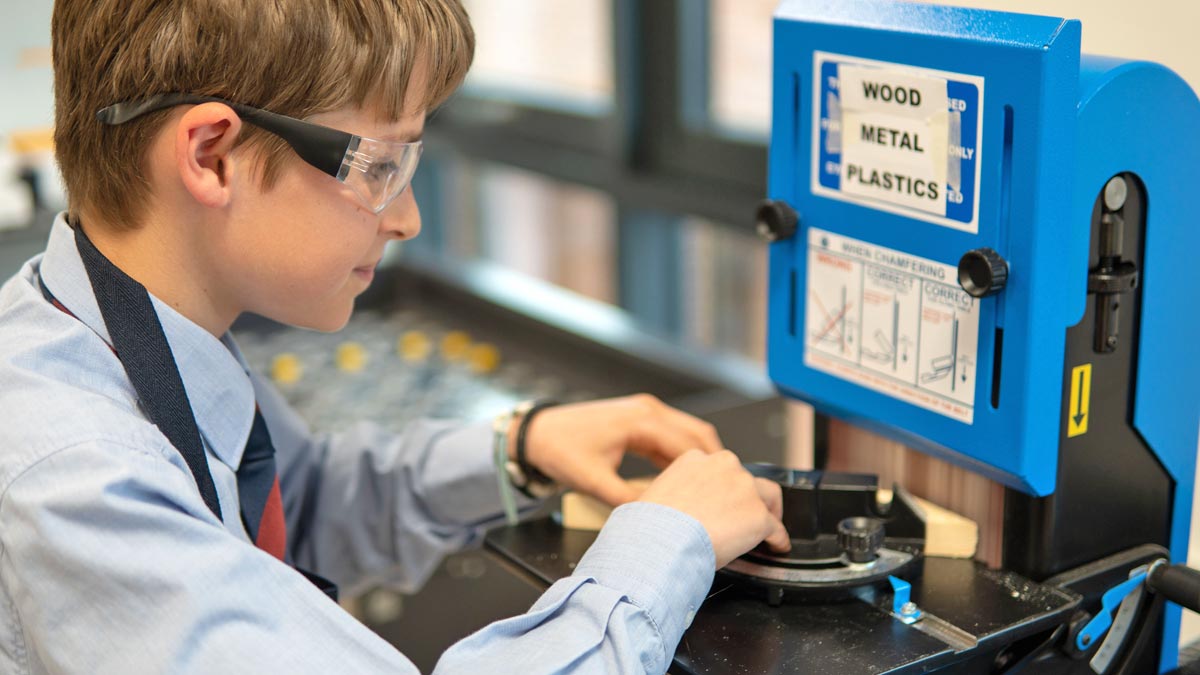
In Design and Technology, pupils work on their Controlled Assessment portfolio (NEA) and practical outcome, which accounts for 50% of their final GCSE mark. As per the AQA specification, they must spend approximately 35 hours on their project which must be completed by the end of the Spring Term. We encourage pupils to attend at least one DT club throughout the academic year to meet this deadline. For the remainder of the year, we focus on product analysis revision and theoretical work in preparation for the summer examination.
AQA Specification
Assessments
Non-exam assessment (NEA)
What’s assessed
Practical application of:
- Core technical principles
- Specialist technical principles
- Designing and making principles
How it’s assessed
- Non-exam assessment (NEA): 30–35 hours approx.
- 100 marks
- 50% of GCSE
Task(s)
- Substantial design and make task
- Assessment criteria:
- Identifying and investigating design possibilities
- Producing a design brief and specification
- Generating design ideas
- Developing design ideas
- Realising design ideas
- Analysing & evaluating
- In the spirit of the iterative design process, the above should be awarded holistically where they take place and not in a linear manner
- Contextual challenges to be released annually by AQA on 1 June in the year prior to the submission of the NEA
- Students will produce a prototype and a portfolio of evidence
- Work will be marked by teachers and moderated by AQA
| Paper 1 |
|
What’s assessed
|
|
How it’s assessed
|
|
Questions Section A – Core technical principles (20 marks) Section B – Specialist technical principles (30 marks) Section C – Designing and making principles (50 marks) |
Drama
Head of Department: Mr Thom Penfold
Overview
In the lead up to their final examinations, pupils will be challenged by a fast pace, exciting curriculum in which they will hone their understanding of Drama practitioners, collaborate in a creative devised performance, explore a performance of a script and develop analytical skills.
Pupils will analyse a performance of Danny’s Boyle’s Frankenstein, from the National Theatre and develop an understanding of why and how theatre is created. Pupils will take part in a scripted assessment in which they will study a play in detail before developing and performing two extracts for assessment. Pupils will find themselves immersed in the world of theatre through trips and digital performances and will gain a great understanding of effective and poignant theatre.
Year 11 Programme of Study
Practitioner Study: Stanislavski, Brecht, Artaud, Ionesco, Boal, Frantic Assembly – exploring the finer details of each practitioner’s techniques and styles with a focus on how each can be used effectively in performance. Students will be given the opportunity to hone these skills in preparation for their first GCSE assessment point.
Component 3: Texts in Practice – Pupils will be given a play to study, they will then develop, rehearse, retain and perform two extracts of this play for an external assessment.
Pupils will work on two extracts of performance from their given play. They may work individually (Monologue) or in pairs (duologue) or small groups
This assessment makes up 20% of the overall GCSE
Component 1: Theatre Theory – Focusing on elements of stage craft: stage positions, stage layouts, theatre roles and responsibilities and beginning to explore theatre analysis and evaluation.
Component 1: Set Text Blood Brothers – Recapping the set text and preparing for the examination questions.
Analysis and Evaluation: Frankenstein – a study of Danny Boyle’s 2011, National Theatre production of ‘Frankenstein’ adapted and written by Nick Dear and starring Jonny Lee Miller and Benedict Cumberbatch.
Component 1 Written Examination – 40%
Section A – 4 Multiple Choice – Stage layouts, positions, roles and responsibilities. [4 marks] Section B – Blood Brothers – Responding to an extract as a performer – 4 questions. [44 marks]
Section C – Live Theatre Review – Frankenstein – An analysis and evaluation of a production watched in lesson – 1 question. [32 marks]
Art & Design
Head of Department: Mrs Felicity Sanders
Overview
Students continue their exploration into their second thematic unit of ‘Layers’, developing further independence in the generation of more comprehensive and skilful ideas. Students may choose to undertake compositions on a range of scales and formats applicable to their ideas, using the full range of media available. One final project set by the exam board follows the Autumn term.
Course Breakdown:
Component 1: Personal Portfolio (Coursework) (60%)
Themes are set internally and comprise of two clearly separate units of work. Support and guidance is provided throughout the components on an individual basis.
Thematic sketchbooks and any larger supportive work must be complete and submitted by the end of the Autumn term.
Component 2: Externally Set Assignment (ESA) (40%)
The exam paper is released on the 1st January. Preparatory work is carried out during the Spring term in lesson time within a sketchbook or on boards prior to the 10-hour timed examination. Support and guidance towards an outcome takes place during lesson time and set homework tasks. Preparatory work is brought to the timed practical and should be referred to during this time. It cannot be worked on after the timed activity starts and remains in school between the two days. The final outcome/s is submitted at the end of the 10-hour period.
Assessment and Further Information
Both sketchbooks relating to components 1 and 2 are marked at regular intervals as a means of tracking using a structured assessment matrix provided by the exam board. The core skills of research, drawing/recording, experimentation with techniques and processes, and a final outcome are assessed holistically to generate a mark out of 72, known as a RAW mark. Students must produce evidence for all four objectives, with component 2 showing further signs of independence.
Students are entitled to their RAW mark for both components in the Summer term after work has been internally standardised.
Live coursework cannot be photographed and must not appear on any social media sites prior to the receipt of results in August.
Homework must be undertaken each week to extend the learning and enhance the content of the two components.
Students can attend a Coursework Clinic after school to maintain a good working pace or develop work further.
A Private View of the work undertaken across the two years is an exciting celebration at the end of the course and takes place post-moderation.
Music
Head of Department: Mr Richard Harris
General Overview
We aim to develop a ‘love of music’ at Cranmore. With your support, we will inspire the pupils to greater musical heights and encourage them to participate in one or more of the many instrumental and choral groups available to them.
Curriculum Overview
Pupils in this Year 11 class will be taught by Mr. Harris and follow the Edexcel 1-9 GCSE Music Course. There will be three hours of study each week.
There are three components to this qualification which are weighted as follows:
- Component 1 (coursework) – Performance 30% of overall mark. The combined length of recorded performances must be at least 4 minutes with each performance lasting over 1 minute.
Solo performance to be recorded in Autumn Term 2026. Ensemble performance to be recorded in Spring Term 2027.
Pupils are encouraged to perform regularly in assembly.
- Component 2 – (coursework) – Composition 30% of overall mark.
The Combined length of compositions must be at least 3 minutes
The free composition will be started and completed in Autumn Term 2026.
The set brief composition will be planned in Autumn 2026 and completed in Spring Term 2027.
- Component 3 – Appraising 40% of overall mark
There are eight set works to learn, two from each Area of Study. They will be studied throughout the two-year course, culminating in the written examination in June 2027.
Six of these set works were studied in Year 10 and will be regularly revisited / revised. The two remaining ‘fusion’ set works will be studied during the Autumn Term of Year 11. Melodic and Rhythmic Dictation will continue to be studied, as will the extended response 12-mark question. Pupils will be expected to complete their composition work during supervised lessons on the free to download, Musescore 4 software installed on the PC’s in A7.
Performing opportunities for Year 11 musicians are plentiful here at Cranmore: Wednesday assembly, Carol Service, Pupil Concerts, Young Musician of the Year Competition and Soiree. Confident musicians will often perform during Mass.
Resources & Information
Pupils will be given an exercise book, and will already own the GCSE Music Anthology. Pearson Study Guides will be issued for each set work. The Music pages of the VLE will be rich is useful content.
Assessment in this subject is based on GCSE grading, is ongoing throughout the year and is based on their success in all three components.
Sport
Head of Department: Mr Paul Hodgson
Overview
Within the Sport programme, we continue the ethos of the subject, which is a wide and varied programme to benefit the pastoral well-being, physical health and sporting enjoyment of all pupils. The aim is to develop the individual core skills for each sport, whilst making sure every pupil fully understands the age relevant rules and laws. Further emphasis is placed on technical and tactical awareness in Year 11, which also allows leadership skills to be developed. Pupils will learn the value of quality practice, training for specific sporting activities and how to follow a process to achieve long-term goals.
- Rugby
- Multi-Sports
- Rowing
- Football
- Hockey
- Cricket
Games: Wednesday
After-school training: Tuesday
Scholarship Session: Tuesday before school plus S&C sessions
Swim Squad: Tuesday after school
Pupils can, if selected, represent the school in the following sports:
- Skiing
- Tennis
- Squash
- Cross-Country
- Athletics
- Golf
- Swimming
Academic PE
Head of Department: Mr Stephen Williams
Overview
Pupils studying OCR GCSE PE will cover five academic topics throughout the two years of study, culminating in two exams in the summer of year 11. Each exam is worth 30% of the overall mark for the course.
Practically, pupils are required to regularly participate in three sports to a competitive standard. They will need to demonstrate the required core and advanced skills from the OCR practical specification. One of these sports must be from the OCR team sport list, one from the OCR individual sport list and one from either list (https://www.ocr.org.uk/Images/234827-gcse-guide-to-non-exam-assessment.pdf). Each sport is worth 10% of the overall mark for the course. If a sport is on the “off-site” list, then video evidence must be collected and submitted to obtain a mark.
Pupils with also complete an analysing and evaluating performance task (AEP), either on their own or a peer’s performance in one of their sports. Using their knowledge and understanding from the theory topics and the practical skill criteria pupils will produce a detailed written piece of work. This will cover the following:
- analyse aspects of personal performance in a practical activity
- evaluate the strengths and weaknesses of the performance
- produce an action plan which aims to improve the quality and effectiveness of the performance.
The AEP task is an individual piece of work that must be completed within 14hours (supervised in school) and is worth 10% of the pupil’s overall mark.
Year 11 Overview
In Year 11 pupils will study the remaining exam content. This will cover Chapter 1.2 Physical Training, Chapter 2.2 sports psychology and Chapter 2.3 Health, fitness and well-being. The movement analysis section will also be revised to help complete corresponding sections of the written coursework.
Pupils will spend 2 hours a week focusing on exam-based material, with the third hour being used to complete the remaining hours of the written coursework (AEP). Time will also be allocated to prepare and assess the pupils 3 practical sports.
During mock exams all pupils will attempt an exemplar paper 1 and paper 2 as they would have learned all the required content. Spring term will comprise of final practical, video evidence and AEP submissions which will be sent to the exam board before the 15th of March. Pupils will also complete significant revision during academic lessons prior to the Easter holidays.
During the Summer term pupils will be selected for live practical cluster moderation by the exam board from the end of April to early May. This will be prior to their public examinations commencing.
Full OCR GCSE PE specification can be found here: https://www.ocr.org.uk/images/234822-specification-accredited gcse-physical-education-j587.pdf
| Year | 11 | ||
| Subject | Physical Education |
||
| Assignment |
Chapter 2.2 – Chapter 2.3 Chapter 1.2 Chapter 3.1 |
||
| Autumn Term (Term 1) |
Exam (2 hrs) 2.2 –Characteristics of skillful movement, classification of skills and goal setting. 1.2 –Warmups, cool downs, preventing injuries and hazards in sporting settings SMART, mental preparation, types of guidance and feedback 2.3 – Health, fitness and well-being |
AEP and Practical (1hr) 3.2 – AEP write up (7hrs) Action plan(4-5hrs) 3.1 – Practicalassessment of performance s and marks awarded |
|
| Spring Term (Term 2) |
Mock Exams – January Exam (2hrs) Contingency time to complete coursework or exam content. Targeted revision based on mock exam feedback. |
Final Practical Assessments (1hr) with final marks given prior to JCQ appeals deadline NEA Marks submitted by 15th March |
|
| Summer Term (Term 3) |
Practical cluster moderation from the end of April to early May. Exams to commence from mid May |
||
Assessment and homework
Pupils with be regularly assessed throughout the year. After each subtopic and topic, pupils will sit in class practice papers to help develop their exam technique and application of knowledge. More formative assessment will be used throughout the different topics in the form of homework tasks and presentations to consolidate the learning that has taken place.
Practically, pupils will be continually assessed throughout the year with summative practical assessments windows scheduled into the school calendar for feedback on all three of the pupils’ practical sports.
Resources
Each pupil will have a Cranmore logo exercise book to complete work and can also bring a device to complete class notes and study.
All pupils will be a loaned an OCR GCSE PE endorsed textbook for the duration of the course to assist with their studies.
Resources from the lessons, specifications and full course content will be placed on the VLE and Class OneNote for pupils to refer to.