Curriculum Notes Year 10
It is a real pleasure to welcome you and your sons back to Cranmore as they begin the next stage of their educational journey; one that marks the official start of their GCSE programme. Having had the privilege of guiding this year group for the past two years, I am delighted to continue as their Head of Year, and I look forward to supporting them once again as they take on new challenges and opportunities with maturity and confidence.
This is a pivotal time for the boys as they begin to specialise in subjects they have chosen, laying the foundations for future academic and personal success. We are excited to help the boys navigate this important stage, and to see them grow into increasingly independent, self-aware young men, ready to meet the demands of Key Stage 4 and beyond.
The Year 10 tutor team comprises: Mr. Minikin, Mr. Phillips, Mrs. Reid and Mr. Kelly. Should you have any questions or concerns at any point, please do not hesitate to get in touch with them directly, or with me.
Chris McGhee
Head of Year 10
chris.mcghee@cranmore.org
Stuart.Minikin@cranmore.org
ciaran.kelly@cranmore.org
antonella.reid@cranmore.org
gareth.phillips@cranmore.org
English
Head of Department: Mr Marcus Chapman
The English course in Year 10 will continue the process of preparing pupils for their English and English Literature GCSEs (set by the AQA examination board) through a carefully balanced programme of study. Pupils will explore a range of texts and be encouraged to think independently while building their skills of analysis and interpretation. The teaching groups will be setted and half termly assessments will allow pupils toreflect on their progress. They will be encouraged to read as widely as possible to develop their understanding, vocabulary and expression. Our work in class will be complemented by other activities including at least one theatre trip to watch a dramatization of one of the GCSE texts.
Year 10: Programme of Study
Christmas Term
AQA Language: focus on Paper 1 – reading questions and narrative/descriptive writing
AQA Literature: 19th Century text – A Christmas Carol
Easter Term
AQA Language: focus on Paper 2 – reading analysis
AQA Literature: Poetry Anthology cluster
Summer Term
AQA Language: focus on Paper 2 – argument writing
AQA Literature: Modern Drama – An Inspector Calls
Resources
Pupils will be given their own copies of the texts studied in Year 10 and will be expected to annotate these as part of their preparation for GCSE. Learning in lessons will be complemented using study guides and workbooks provided with each unit of work. The Key Stage 4 Reading List offers an excellent starting point for pupils in choosing new novels to read. Reading widely not only helps pupils secure success in English but across a range of subjects at GCSE.
Mathematics
Head of Department: Mr Christopher Savvides
Mathematics is fundamental to many areas of our lives, and it is therefore crucial that we equip our children with the necessary skills to become confident, logical and resilient problem solvers as they embark on their journey to adulthood.
We believe that Mathematics should be engaging, challenging, practical and interactive. We make the most of Mathematics challenges and team competitions to encourage participation and ensure ourchildren are enthusiastic and motivated mathematicians. We endeavour to utilise various methods and techniques across the curriculum and instil a love for mathematics into each pupil.
In Year 10, all students embark on the same Higher scheme of work for Mathematics, which is based on an Enhanced National Curriculum, with a focus on problem solving, mastery and fluency. Our most able mathematicians also study Extended Mathematics above and beyond our main scheme of work.
Year 10: Programme of Study
Number: calculations with bounds indices and standard form, percentages and compound interest.
Algebra: Algebraic fractions, quadratics, solving more challenging equations, changing the subject of formulae, quadratic sequences, line segments, curved graphs, units and compound measure, tangents and area under graphs, the quadratic formula, simultaneous equations.
Shape, space and measure: Sectors of circles, volume of spheres pyramids and cones, constructions, review of trigonometry, transformations, circle theorems.
Data Handling: Counting outcomes, relative frequency and probability diagrams, interpreting and representing data.
Resources
Pupils use the Rayner GCSE Higher series of textbooks published by Oxford University Press. We have carefully mapped our curriculum on https://www.drfrost.org so that pupils have access to a vast library of appropriate problems for consolidation. Pupils and teachers also use https://www.mathspad.co.uk/ as an excellent resource to further develop understanding of topics.
Our VLE pages contain lots of information, links and resources to support your son with their learning and progress.
There are a wide range of hugely impactful interactive resources available to us online and the quality of these resources have increased hugely over recent years. As a department we are constantly sharing what works best and we keep on top of innovative resources and approaches to teaching Mathematics.
In addition to our classroom provision, pupils also have access to our drop-in support session, MathsLink, which takes place on a Friday lunchtime, and our Maths Challenge club, which takes place on a Thursday after school.
Science
Head of Department: Mr Stuart Minikin
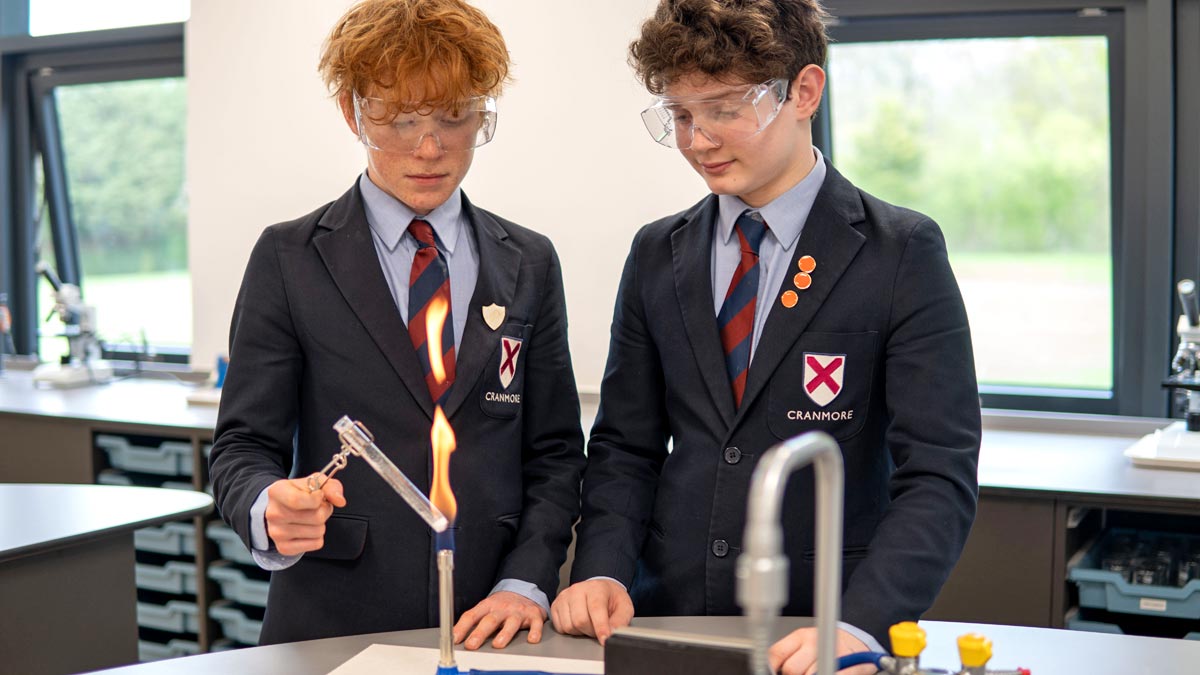
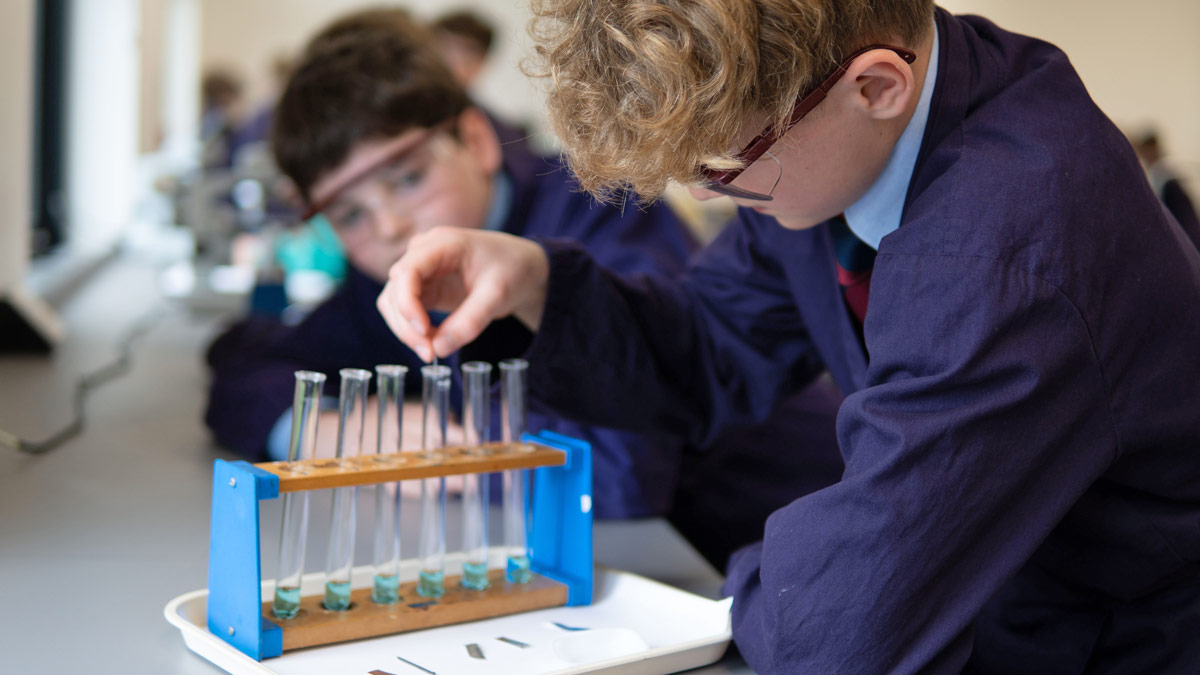
At Cranmore our aim is to develop scientists with a rigorous understanding of the subject, an enthusiasm for learning and the confidence to question, evaluate and articulate their ideas. We encourage all students to develop a love for science by balancing theory with practical work and placea high value on developing the technical and analytical skills needed to investigate experimentally. We create a safe environment in which the students feel comfortable exploring their understanding and where we can add to both their knowledge and skills. We focus on developing a meticulous approach to practical investigations which are used as often as possible, to support the learning of theory. Our students enjoy science and develop techniques that will be useful to them for the rest of their lives.
YEAR 9: Programme of Study
Biology
- The Heart and Lungs
- The Immune System
- Photosynthesis
- Ecology
Chemistry
- Quantitative Chemistry
- Energy Changes in Reactions
- Rate and Extent of Chemical Change
- Organic Chemistry
Physics
- Circuit and Domestic Electricity
- Kinetic Theory
- Atomic Structure and Radioactivity
- Forces
Resources & Information
Science is taught by specialist teachers and pupils will be assessed regularly, usually at the end of each topic, to support their progress. The Science Department enjoys the use of large laboratories and two prep rooms which are well provisioned for the learning of the science curriculum. Our Science Technicians ensure the preparation of the equipment for practical activities and support the teaching staff on a daily basis. Additional resources, together with details of homework, can be found on the VLE.
Languages
Head of Department: Miss Christine Ebdy
Our philosophy as a department is to inspire and motivate the pupils by giving them a positive, lively and enjoyable experience of foreign language learning. We especially strive to acknowledge the individuality of every pupil with his unique talents. We aim to help all children to become confident on their journey of linguistic discovery, improving their own skills and developing them steadily to their full potential. For this to be achieved, our pupils must naturally have a positive attitude to the subject, and we see it as part of our task to foster such an attitude.
Resources & Information
For all 3 language subjects, the pupils will have weekly vocabulary tests and end of topic assessments throughout the year and an end of year exam in May, assessing productive skills.
The pupils will have access to a variety of resources and material including https://activehub.pearson.com, https://www.languagesonline.com, and https://www.conjuguemos.com. Additional resources are available on the VLE and students are provided with a vocabulary booklet.
Homework will consist of vocabulary learning and interactive tasks to reinforce what has beentaught in the lessons. Students will start preparation towards their final speaking exam and practise extended written paragraphs.
French
In French, pupils will study AQA GCSE (2024) French Higher modules 3-6. They will revise the perfect, immediate future and present regular and irregular tenses across a variety of topics. Pupils will continue to develop their reading, listening, speaking, writing and translation skills.
Year 10: Programme of Study
Module 3
Topics & Vocabulary
- Primary school
- Learning languages
Grammar
- Imperfect tense
- Imperfect, present and near future tenses
Module 4
Topics & Vocabulary
- Opinions about dishe
- Meals and mealtimes
- Good mental health
- Unhealthy lifestyle choices
- Improve your life
- Lifestyle changes
Grammar
- Vous form imperative
- Partitive article
- Modal verbs
- Perfect tense of reflexive verbs
- Simple future tense
- Imperfect, present and simple future tenses
Module 5
Topics & Vocabulary
- Holidays
- Ideal holiday
- What you can see and do
- Festivals
- Booking holiday accommodation
- Staycation activities
Grammar
- Je voudrais / J’aimerais
- Conditional tense
- Forming questions
- Perfect and imperfect tense
- Perfect tense of modal verbs
- Range of tenses and si clause with present + simple future tense
Module 6
Topics & Vocabulary
- Our planet
- Geography and climate
- Environmental problems
- Protecting the planet
- New technologies
Grammar
- Numbers & percentages
- Comparatives and superlatives
- Present tense of the passive
- Nous form imperative
- En + present participle
- Être en train de and venir de + infinitive
Spanish
In Spanish, pupils will study AQA GCSE (2024) Spanish Higher modules 3-6. They will revise the preterite, immediate future and present regular and irregular tenses across a variety of topics. They will also learn the imperfect tense. Pupils will continue to develop their reading, listening, speaking, writing and translation skills.
Year 10: Programme of Study
Module 3
Topics & Vocabulary
- Different families
- Describing people
- Your favourite celebrities
- Friendships and relationships
- Your identity and what matters to you
- Problems and advice
- Family celebrations
Grammar
- Possessive adjectives
- Present continuous to describe a photo
- Ser and estar
- Using the personal ‘a’
- Reflexive verbs
- Me and te before a verb
- Para + infinitive
- Podrías /Deberías + infinitive
- Indirect object pronouns
- Using a range of preterite tense verb forms
Module 4
Topics & Vocabulary
- Typical foods in Spanish-speaking countries
- Healthy daily routines
- Mealtimes and food trends
- Comparing old and new habits
- Illnesses
- Making future plans for health and wellbeing
Grammar
- Adjectives of nationality
- Indefinite adjectives
- Tener + noun
- Direct object pronouns
- Imperfect tense
- Ya no + verb
- Reflexive verbs in the preterite tense
- Debes, tienes que and necesitas
- Simple future tense
Module 5
Topics & Vocabulary
- Schools in Spain
- A typical school day
- Talking about your studies
- How you would change your school
- Students and teachers at school
- Describing a school trip in the past
Grammar
- Absolute superlatives
- Relative pronouns que, donde, cuando
- Lo que
- Conditional tense
- Impersonal verbs with an infinitive
- Negatives
- Forming questions
- Adjectives and adverbs
- False friends
Module 6
Topics & Vocabulary
- Colombia
- Cities
- How a city or town has changed
- Shopping preferences
- Preferences about where you live
- Your area
Grammar
- Demonstrative adjectives
- Perfect tense
- Demonstrative adjectives
- Direct object pronouns
- Present subjunctive and cuando
- A variety of verb tenses
Latin
Latin will be learnt using Cambridge Latin Course Book 2 and 3 (Stages 16-22) and online activities, as well as reading comprehensions, and translation activities from Latin to GCSE Part 1 and Part 2. The pupils will have access to www.clc.cambridgescp.com and www.languagesonline.org. We encourage the use of these resources at home and in school.
Year 10: Programme of Study
Grammar:
- Nouns: Introduction of genitive and ablative cases of 3 declensions.
- Nouns: the plural of neuter nouns.
- Syntax: sentences containing infinitive with modal verbs.
- Syntax: relative clauses with qui, quae, quod (that, which, who).
- Syntax: sentences with cum and ut.
- Verbs: imperfect tense of the verb esse, possum, nolo, volo and ire.
- Verbs: Imperfect and Perfect Tenses: all persons – revision and introduction of perfect stems, irregular stems.
- Verbs: Introduction of Pluperfect tense: all persons.
- Introduction of a present participle.
- Participles: perfect passive participle, perfect active participle.
- Subjunctive: pluperfect subjunctive, imperfect subjunctive.
- Adjectives: third declension adjectives
- Indirect questions and commands.
- Pronouns: qui, quae, quod; ille, illa, illud: hic, haec, hoc; is, ea, id.
Vocabulary:
- Around 20-30 words per Stage which are also on the GCSE vocabulary list.
- Derivation work to make connections between Latin vocabulary and English, French and Spanish vocabulary.
Culture:
- Roman history is combined with the language throughout, and the influence of the Romans, and similarities and differences between ancient and modern society explored.
Topics are Roman Britain, Roman army and life as a Roman soldier.
Religious Education
Head of Department: Mr Graham West
Overview
Religious Education at Cranmore is a subject that enriches all pupils. It helps pupils to discover and learn more about who God is, more about who they are in themselves and more about the world in which they live. It also gives pupils a greater understanding of how we can live in community. Pupils in Year 10 will be continuing the GCSE Religious Studies B Catholic Christianity with Judaism.
Year 10 will cover the following topics this year:
Paper 1
- Applied Themes A- Religion, relationships and families -Theme B: Religion, peace and conflict -Theme C: Religion, human rights and social justice
Paper 2
- Catholic Christianity- Creation, The Triune God, Redemption, Church and the Kingdom of God, Eschatology,
Resources & Information
Within RE we use a range of teaching techniques and activities that enable all pupils of different learning styles to engage and succeed. Activities include essay writing, drama, debate and ICT.
Short assessments will take place in class at the end of each term and these enable the pupils to be fully prepared for the end of year assessments. Homework will be given weekly and can be found on the VLE.
History
Head of Department: Mr Rhys Cross
In Year 10, we begin by examining medieval medicine. We proceed to analyse medical developments through to the present day. A depth study of surgical advancement during with First World War will also be incorporated. During the latter half of the Spring Term, we will shift our attention to Elizabethan England, which is a shorter topic. This is understandable given that it only makes up half of Paper 2.
Year 10: Programme of Study
Paper 1: Medicine Through Time, c1250-present
- c1250–c1500: Medicine in medieval England
- c1500–c1700: The Medical Renaissance in England
- c1700–c1900: Medicine in 18th and 19th century Britain
- c1900–present: Medicine in modern Britain
- The British sector of the Western Front, 1914–18: surgery and treatment
Paper 2: Section A – Early Elizabethan England 1558-88
- Key Topic 1: Queen, Government and Religion, 1558-69
- Key Topic 2: Challenges to Elizabeth at home, 1569-88
- Key Topic 3: Challenges to Elizabeth abroad, 1569-88
- Key Topic 4: Elizabethan Societ
- Key Topic 5: Early Exploration in the Elizabethan era
Resources and Information
There are three papers for the History GCSE, with papers 1 and 3 weighing 30% and paper 2 40% respectively. There are a variety of essay, source and interpretation questions which students must answer across the three papers. Specifically, each paper has an essay question worth 16 marks. The skills developed are as follows: analysis of interpretations, explanation of cause and consequence, knowledge retention and extended writing.
The History Department is fortunate to be well provisioned. Relevant digital clips, up to date textbooks designed specifically for GCSE, bespoke PowerPoints and various worksheets will all be utilised in the learning process, as well as personal devices. Information pertainingto all topics covered can be found on the VLE. A catalogue of revision material will be available prior to any exam.
If you wish to purchase your own textbook for home use, I advise investing in the ‘Hodder’ textbooks, rather than ‘Pearson’. Please feel free to email rhys.cross@cranmore.org if you would like specific guidance on which textbooks to buy.
Geography
Head of Department: Mr Mark Spalton
In Y10 students learn four of the six topics for the AQA GCSE specification. Students will develop their content knowledge, their written explanations, their ability to evaluate and justify opinions and their data analysis skills. This year will give students a wider understanding of both human and physical geography and delve into specific examples from around the world.
Paper 1: Section A – The Challenge of Natural Hazards
- Tectonic Hazards
- Atmospheric Hazards
- UK Extreme Weather
- Climate Change
Paper 2: Section A – Urban Issues and Challenges
- Urban Trends
- LIC/NEE Urban case study – Rio De Janeiro
- HIC Urban case study – London
Paper 1: Section C – UK Physical Landscapes
- Rivers
- Coasts
Paper 2: Section C – The Challenge of Resource Management
- Food
- Water
- Energy
Paper 3: Section C – Fieldwork
- River analysis of the Beverley Brook in Wimbledon Common
Resources and Information
The GCSE is assessed through the following assessment objectives: AO1 – knowledge; AO2 – explanations and understanding; AO3 – evaluation and application; AO4 – data analysis. Ongoing assessment will take place at the end of each topic within units with more formal assessments at the end of each unit.
The VLE along with their associated textbooks provide a good range of resources from which to develop their understanding. In addition, the BBC bitesize and SENECA learning sites for additional revision materials for AQA GCSE Geography can be very useful. It will be very important for students to keep up to date with current events and the news throughout their GCSE geography course. A full list of wider reading and watching will be given to the students.
Computing
Head of Department: Mr Ahmed Afana
In OCR GCSE Computer Science, pupils will learn how to apply fundamental concepts of Computer Science through the course’s two main units. Pupils will be empowered to gain critical thinking skills and real-world knowledge to design systems and understand human vs. machine learning. The course leads to a wide range of courses at A Level and university. The course opens a diverse career path and roles in data science, artifice intelligence, game design, web and animation development or network security, digital forensics and mobile app development.
The course has two main units, and both are assessed through two written examinations at the end of year 11. Each exam is worth 50%.
Unit 01: Computer Systems:
Autumn Term:
- 1.1 Systems architecture
- 1.2 Memory and storage
- 1.3 Computer networks, connections and protocols
Spring Term:
- 1.4 Network Security
- 1.5 Systems software
- 1.6 Ethical, Legal, cultural and Environmental Impacts of digital technology
Summer Term:
Unit 02: Computational thinking, algorithms, and programming:
- 2.1 Algorithms
- 2.4 Boolean logic
Assessment opportunity:
- Frequent online assessments covering key terms of the topic.
- A written assessment at the conclusion of each topic
- Regular assessments are integrated into the curriculum to reinforce learning and ensure academic progress.
Resources and revision:
Pupils will have access to a wide range of learning resources including:
1. OneNote: for lesson notes, activities, Key Terminology tables, and Knowledge Organisers.
2. Textbook
3. Eudcake: for Homework and revisions.
Design & Technology
Head of Department: Mr Chris McGhee
Overview
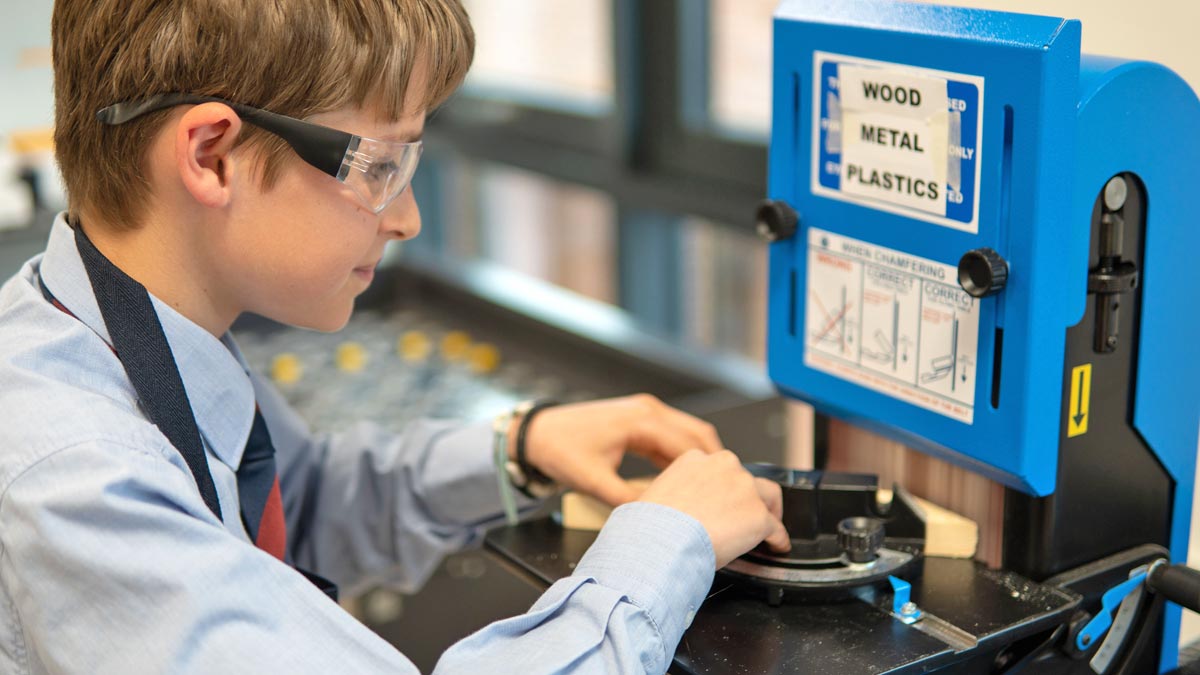
Taught in small groups, pupils have three double lessons a week, mainly devoted to developing practical skills and providing opportunities for product analysis and project development. The theoretical aspects of the syllabus are addressed during one of these lessons, with particular emphasis on properties of materials, manufacturing techniques and product analysis. The theoretical aspects of the syllabus are complementedby a series of short practical projects. At the end of the academic year pupils choose a topic based on three set contexts released on the 1st of June, for their coursework and are encouraged to gather research material over the summer in preparation for Year 11. We encourage pupils to attend DT club to further their skills and knowledge across the academic year.
The emphasis of the course is on building independence and creativity.
Assessments
Paper 1
What’s assessed
- Core technical principles
- Specialist technical principles
- Designing and making principles
How it’s assessed
- Written exam: 2 hours
- 100 marks
- 50% of GCSE
Questions
Section A – Core technical principles (20 marks)
A mixture of multiple choice and short answer questions assessing a breadth of technical
knowledge and understanding.
Section B – Specialist technical principles (30 marks)
Several short answer questions (2–5 marks) and one extended response to assess a more in-depth knowledge of technical principles.
Section C – Designing and making principles (50 marks)
A mixture of short answer and extended response questions.
Non-exam assessment (NEA)
What’s assessed
Practical application of:
- Core technical principles
- Specialist technical principles
- Designing and making principles
How it’s assessed
- Non-exam assessment (NEA): 30–35 hours approx.
- 100 marks
- 50% of GCSE
Task(s)
- Substantial design and make task
- Assessment criteria:
- Identifying and investigating design possibilities
- Producing a design brief and specification
- Generating design ideas
- Developing design ideas
- Realising design ideas
- Analysing & evaluating
- In the spirit of the iterative design process, the above should be awarded holistically where they take place and not in a linear manner
- Contextual challenges to be released annually by AQA on 1 June in the year prior to the submission of the NEA
- Students will produce a prototype and a portfolio of evidence
- Work will be marked by teachers and moderated by AQA
Drama
Head of Department: Mr Thomas Penfold
An exciting challenge presents itself this year with the start of GCSE Drama study. This year will see an uptick in the challenge of our exploration with focus on key practitioners, performance styles and techniques but also with a focus on developing an understanding of analysis and evaluation of performance. Students will complete the first of three GCSE assessment points this year, component 2: Devising Drama in which they will create a piece of original theatre inspired by a booklet of stimuli.
GCSE Drama students will develop a well-rounded and balanced approach to theatre, both in the performance skills and the ability to analyse the performance of others to determine what could be implied. This year will prove a challenging and rewarding experience for students as they begin their journey into the world of performance.
Year 10 Programme of Study
Practitioner Study: Stanislavski, Brecht, Artaud, Ionesco, Boal, Frantic Assembly – exploring the finerdetails of each practitioners techniques and styles with a focus on how each can be used effectively in performance. Students will be given the opportunity to hone these skills in preparation for their first GCSE assessment point.
Component 2: Devising Drama – Pupils will collaborate on an original performance inspired by
the practitioners studied, their autonomous research and inspired by a booklet of stimuli provided.
Component 1: Theatre Theory – Focusing on elements of stage craft: stage positions, stage
layouts, theatre roles and responsibilities and beginning to explore theatre analysis and evaluation.
Analysis and Evaluation: Frankenstein – a study of Danny Boyle’s 2011, National Theatre
production of Frankenstein starring Jonny Lee Miller and Benedict Cumberbatch.
Set Text: Blood Brothers – an exploration of our GCSE set text, focusing on the performance skills
used to bring the text to life as well as character motivation, subtext, themes and audience impact.
Students will get an insight into Willy Russell’s classic play through the practical exploration and
theoretical study of the text.
Resources & Information
Pupils will also be advised to attend local theatre to broaden their experience of live performances.
There will be additional rehearsal times for GCSE pupils at lunch and after school to support their progress. Optional private lessons with the opportunity to take LAMDA exams are available, and all pupils are encouraged to participate in the senior production.
Art & Design
Head of Department: Mrs Felicity Sanders
Overview
Pupils will produce work on the theme of ‘Natural Structure’ in their first unit of work in Year 10. This body of work provides an introduction to the course and allows pupils to explore the full range of media available through printmaking, sculpture and observational work. This early unit is mounted by students as a portfolio of work.
Students will then explore a second theme to further learning, working with more independence to generate a greater body of work that is more diverse, taking them into Year 11.
Course Breakdown:
Component 1: Personal Portfolio (Coursework) (60%)
Themes are set internally and comprise of two units of work. Support and guidance is provided throughout the component on an individual basis.
Thematic sketchbooks and larger supportive work must be completed by the end of the Christmas term in Year 11.
Component 2: Externally Set Assignment (ESA) (40%)
The exam paper is released on the 1st January. Preparatory work is carried out during the Spring term in lesson time within a sketchbook prior to the 10-hour timed examination. Support and guidance towards an outcome takes place during lesson time and set homework tasks. The final outcome/s is submitted at the end of the 10 hour period, along with the preparatory work.
Assessment and Further Information
The thematic sketchbooks are marked at regular intervals as a means of tracking using a structured assessment matrix provided by the exam board. The core skills of research, drawing/recording, experimentation with techniques and processes, and a final outcome are assessed individually and holistically to generate a predicted grade between 1-9. Students must produce evidence for all four objectives.
Live coursework cannot be photographed and must not appear on any social media sites.
Homework is undertaken each week to extend the learning and enhance the content of the two components. Students can attend a Coursework Clinic after school to maintain a good working pace or undertake extension work.
Music
Head of Department: Mr Richard Harris
General Overview
The Edexcel Music GCSE is a wonderful course, where pupils will have the opportunity to show their skills in three different areas of musicianship.
Curriculum Overview
Pupils in this Year 10 class will be taught by Mr. Harris and follow the Edexcel 1-9 GCSE Music Course. There will be three hours of study each week.
There are three components to this qualification which are weighted as follows:
- Component 1 (coursework) – Performance 30% of overall mark
Performance (solo and ensemble pieces to be recorded, marked and submitted by May 2027). Pupilswill be required to perform regularly, and each pupil will be asked to perform once a term during
assembly. - Component 2 – (coursework) – Composition 30% of overall mark
Composition (free composition in Year 10 and set brief composition in Year 11) - Component 3 – Appraising 40% of overall mark
Appraising (eight set works to learn, two from each Area of Study, will be studied through the two
year course) culminating in a written examination in June 2027.
Performing opportunities for Year 10 musicians are plentiful here at Cranmore: Monday assembly, Carol Service, House Music Competition, Pupil Concerts, Young Musician of the Year Competition and Soiree. Pupils should consider entering one of the solo classes at a local music festival to further their performance experience.
Resources & Information
Although some of the composition lessons will take place in S18 later in the course, pupils will need their own device, with ear buds/headphones and the latest version of MuseScore loaded. Parents will be required to purchase the Edexcel GCSE Music Anthology before the course commences.
Pupils will be given a ring binder folder, exercise book, textbook and Pearson Study Guides for each of the eight-set works.
Assessment in this subject is based on GCSE grading, is ongoing throughout the year, and is based on their success in all three components.
Sport
Head of Department: Mr Paul Hodgson
Overview
Within the Sport programme, we continue the ethos of the subject, which is a wide and varied programme to benefit the pastoral well-being, physical health and sporting enjoyment of all pupils.
The aim is to develop the individual core skills for each sport, whilst making sure every pupil fully understands the age relevant rules and laws. Further emphasis is placed on technical and tactical awareness in Year 9, which also allows leadership skills to be developed. Pupils will learn the value of quality practice, training for specific sporting activities and how to follow a process to achieve long-term goals.
Pupils have options which include the following sports:
- Rugby
- Multi-Sports
- Rowing
- Football
- Hockey
- Cricket
Games: Thursday
After-school training: Wednesday
Scholarship Session: Tuesday before school and S&C sessions
Swim Squad: Tuesday after school
Pupils can, if selected, represent the school in the following sports:
- Skiing
- Tennis
- Squash
- Cross-Country
- Athletics
- Golf
- Swimming
Academic PE
Head of Department: Mr Stephen Williams
Overview
Pupils studying OCR GCSE PE will cover five academic topics throughout the two years of study, culminating in two exams in the summer of year 11. Each exam is worth 30% of the overall mark for the course.
Practically, pupils are required to regularly participate in three sports to a competitive standard.
They will need to demonstrate the required core and advanced skills from the OCR practical specification. One of these sports must be from the OCR team sport list, one from the OCR individual sport list and one from either list (https://www.ocr.org.uk/Images/234827-gcse-guide-to-non-exam assessment.pdf). Each sport is worth 10% of the overall mark for the course. If a sport is on the “off site” list, then video evidence must be collected and submitted to obtain a mark.
Pupils with also complete an analysing and evaluating performance task (AEP), either on their own or a peer’s performance in one of their sports. Using their knowledge and understanding from the theory topics and the practical skill criteria pupils will produce a detailed written piece of work. This will cover the following:
- analyse aspects of personal performance in a practical activity
- evaluate the strengths and weaknesses of the performance
- produce an action plan which aims to improve the quality and effectiveness of the performance.
The AEP task is an individual piece of work that must be completed within 14hours and is worth 10% of the pupil’s overall mark.
Year 10 Overview:
In Year 10 pupils will study a range of topics to introduce them to the requirements and content of the OCR GCSE PE specification. They will begin with studying content from the socio-cultural influences (Component 02) section and progress onto applied anatomy and physiology and physical training (Component 01). Pupils will spend two hours a week in the classroom focusing on the theoretical side of the course. Pupils will also receive one hour of practical time each week to learn, practise and develop the requirements for their chosen sports (Component 04).
As the year progresses, pupils will commence their written coursework (AEP – Component 05) and complete half of the controlled assessment (7hrs) in the summer term.
Full OCR GCSE PE specification can be found here:
https://www.ocr.org.uk/images/234822 specification-accredited-gcse-physical-education-j587.pdf
| Autumn Term (Term 1) |
Exam (2 hrs) 2.1 – Understand thekey factors affecting participation in physical activity and sport. The role of commercialization of physical activity and sport and the ethics of sport. 1.1 – Skeletal system, location of bones, synovial joints, and types of movement possible |
Practical (1hr) 3.1 – Introduction to practical performances. Initial practical assessments. |
|
| Spring Term (Term 2) |
Exam (2hrs) 1.1 – Muscular system, |
Practical (1hr) 3.1 – Continued assessment of seasonal practical sports. First draft video evidence to be submitted. Current marks for candidates to be shared with pupils. |
|
| Summer Term (Term 3) |
Exam (2hr) 1.2 – Physical training Components of fitness, data collection and principles of training. |
AEP (1hr) 3.2 – AEP write up (7hrs): Evaluation (2-3hrs) Analysis, overview, assessment (3-4hrs) Practical (ongoing) Video evidence and assessment of summer sports events (Athletics). |
|
Assessment and homework:
Pupils will be regularly assessed throughout the year. After each subtopic and topic, pupils will sit in class practice papers to help develop their exam technique and application of knowledge. More formative assessment will be used throughout the different topics in the form of homework tasks and presentations to consolidate the learning that has taken place. Pupils can expect to receive one piece of homework a week.
Practically, pupils will be continually assessed throughout the year with summative practical assessments windows scheduled into the school calendar for feedback on all three of the pupils’ practical sports.
Resources:
Each pupil will have a Cranmore logo exercise book to complete work and can also bring a device to complete class notes and study.
All pupils will be a loaned an OCR GCSE PE endorsed textbook for the duration of the course to assist with their studies.
Resources from the lessons, specifications and full course content will be placed on the VLE and Class OneNote for pupils to refer to.