Curriculum Notes Year 7
Meet the Headmaster
A warm welcome to all our Year 7 pupils. I am confident that you will have an enriching experience and enjoy the outstanding facilities at the school that are complemented by our nurturing staff. At Cranmore, we work to enable you to develop individual talents, achieve academically and develop personally so that you thrive.
Academically, you will be taught the curriculum by specialist teachers, this is just one part of your growing to be a confident, independent and accomplished young person. There are lots of opportunities for you to do things that you enjoy, take part in activities that you may already excel at and to try new challenges. I encourage you to take advantage of all that is on offer. As you develop individually, also remember to support one another and be excellent role models.
Enjoy your journey at Cranmore.
Mr Barry Everitt, September 2026
Meet the Headmaster of Year 7
A huge welcome to Cranmore Senior School!
The transition to Senior School is one of the biggest and most significant changes in a pupil’s educational journey. This is why, at Cranmore, we place the upmost importance on getting it right to ensure that all our new Year 7 pupils are happy, motivated and primed to be the best that they can be.
I have shared with the pupils three main foci for their time in Year 7, which I will continue to revisit over the year:
- Our relationship with ourselves (taking pride over appearance and possessions, building independence and resilience, understanding our own values)
- Our relationship with other people (Working well with others, showing kindness and empathy, Building friendships)
- Our relationship with our world and community (showing curiosity and a love of learning, being open to views and beliefs, being ambitious and stepping up)
Should you have any questions please do not to hesitate to contact me or any of the Year 7 team.
Chris Savvides
chris.savvides@cranmore.org
Key People
| Mr Barry Everett Headmaster | barry.everitt@cranmore.org |
| Mr James Pulford Deputy Head (Academic) | james.pulford@cranmore.org |
| Ms Jessica Schembri Deputy Head (Pastoral) Designated Safeguarding Lead | jessica.schembri@cranmore.org |
| Mr Thom Penfold 7TP Form Tutor | thom.penfold@cranmore.org |
| Mr Will Lamport 7WL Form Tutor | william.lamport@cranmore.org |
| General Enquiries | office@cranmore.org |
| Medical Centre | nurse@cranmore.org |
| Transport Manager | simon.lewis@cranmore.org |
English
Head of Department: Mr Marcus Chapman
Teaching will be through a variety of modern and classic texts that focus on the concept of identity.
Pupils will initially be encouraged to examine cultural issues impacting the modern world via the study of the novel Boy Everywhere. They will then move onto a poetry unit and later a creative writing unit before exploring the Shakespearean comedy A Midsummer Night’s Dream in the summer term.
Language study in Year 7 will again review all punctuation from capital letters to hyphens, relative pronouns; simple, compound and complex sentences; proofreading exercises. There will be an emphasis upon developing vocabulary.
Focus will be upon writing for different audiences and improving style. Texts will prompt tasks including story, description, recount, factual report, diary, biography/autobiography, book review, newspaper report, formal and informal letters, persuasive writing, simple discursive writing, speech, play script, information posters and personal poetry.
Speaking and listening skills will be developed though class discussion, role-play, hot-seating, book presentations and formal debate.
Each class will have a weekly library lesson. Pupils are encouraged to read regularly and widely as this is one of the foundation stones of success in English and, indeed, in many other subjects.
There will be two homeworks per week which should each take approximately 20 – 25 minutes. Homework may consist of nightly reading for 20 minutes or revision of spellings and vocabulary. Students may additionally be asked to produce small amounts of research or complete writing tasks.
Mathematics
Head of Department: Mr Chris Savvides
Mathematics is fundamental to many areas of our lives, and it is therefore crucial that we equip our children with the necessary skills to become confident, logical and resilient problem solvers as they embark on their journey to adulthood.
We believe that Mathematics should be engaging, challenging, practical and interactive. We make the most of Mathematics challenges and team competitions to encourage participation and ensure our children are enthusiastic and motivated mathematicians. We endeavour to utilise various methods and techniques across the curriculum and instil a love for mathematics into each pupil.
In Year 7, all students follow the same scheme of work for Mathematics, which is based on an enhanced National Curriculum, with a focus on problem solving, mastery and fluency.
Year 7: Programme of Study
Number: Arithmetic with integers, negative numbers, fractions and decimals. Converting fractions, decimals and percentages. Factors, primes, multiples and powers. Calculator skills. Working with ratio.
Algebra: Sequences, expressions and formulae. Plotting coordinates and understanding basic graphs. Solving linear equations.
Shape, space and measure: Symmetry. Angle rules. Converting units. Area and perimeter of 2D shapes.
Data Handling: Probability, averages and range. Interpreting charts, including pie charts.
Resources
Pupils use the Essential Maths series of textbooks published by Elmwood Press. We have carefully mapped our curriculum on https://www.drfrost.org so that pupils have access to a vast library of appropriate problems for consolidation. Pupils and teachers also use https://www.mathspad.co.uk/ as an excellent resource to further develop understanding of topics. Our VLE pages contain lots of information, links and resources to support your son with their learning and progress.
There are a wide range of hugely impactful interactive resources available to us online and the quality of these resources have increased hugely over recent years. As a department we are constantly sharing what works best and we keep on top of innovative resources and approaches to teaching Mathematics.
In addition to our classroom provision, pupils also have access to our drop-in support session, MathsLink, which takes place on a Friday lunchtime, and our Maths club, which takes place on a Thursday after school.
Science
Head of Department: Mr Stuart Minikin
At Cranmore our aim is to develop scientists with a rigorous understanding of the subject, an enthusiasm for learning and the confidence to question, evaluate and articulate their ideas. We encourage all students to develop a love for science by balancing theory with practical work and place a high value on developing the technical and analytical skills needed to investigate experimentally. We create a safe environment in which the students feel comfortable exploring their understanding and where we can add to both their knowledge and skills. We focus on developing a meticulous approach to practical investigations which are used as often as possible to support the learning of theory. Our students enjoy science and develop techniques that will be useful to them for the rest of their lives.
YEAR 7: Programme of Study
Biology
- Reproduction in Plants
- Healthy Living – Drug Addiction and Exercise
- Diseases Caused by Bacteria and Viruses
- Cells and Microscopy
Chemistry
- The Particle Model
- Pure and Impure Substances
- Separating Mixtures
- Atoms, Elements, Compounds and The Periodic Table
Physics
- Light and Sound Waves
- Reflection, Refraction and Dispersion
- Kinetic Theory and Heat Transfer
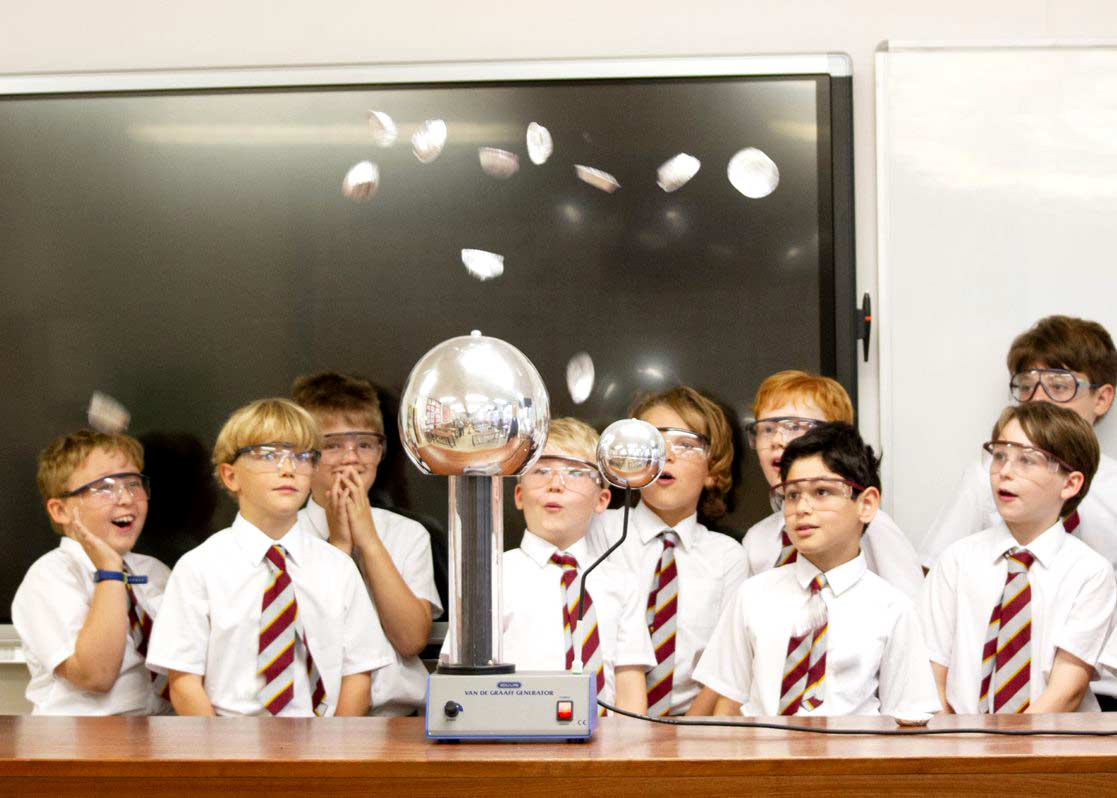
- Electricity and Electromagnetism
Resources & Information
Science is taught by specialist teachers and pupils will be assessed regularly, usually at the end of each topic, to support their progress. The Science Department enjoys the use of large laboratories and two prep rooms which are well provisioned for the learning of the science curriculum. Our Science Technician ensures the preparation of the equipment for practical activities and supports the teaching staff on a daily basis. Additional resources, together with details of homework, can be found on the VLE.
History
Head of Department: Mr Rhys Cross
Year 7 History is arguably the most exciting at Cranmore! Although we will cover a range of themes throughout the year, ranging from crime to clothing, our underlying focus will be medieval warfare! Case studies will involve several crunching and bloody battles such as Bannockburn (1314), Crecy (1341) and Agincourt (1415). Make sure you have your battle-axe at the ready, or perhaps you prefer the lethal longbow…
YEAR 7: Programme of Study
- Edward I in Wales and Scotland
- Depth Study: Medieval Warfare
- The Black Death
- The Peasants’ Revolt
- Wars of the Roses
- The Renaissance & The Reformation in Europe
- Early Tudors – Henry VII to Edward VI
Resources & Information
Students will begin to develop an understanding of important historical concepts such as:
- Long and short-term causes
- Cause and effect/consequences
- Provenance of a source – meaning, importance, reliability and usefulness
- Eyewitness accounts, hindsight, research by a modern-day historian
Year 7 students will be expected to demonstrate an in-depth level of analysis when evaluating historical sources and to demonstrate that they have the ability, even at this stage, to write fluently and with a clearly defined structure. Essays will be expected to be balanced, proceeding to a substantiated judgement. Examinations will take place in January and in May and regular assessment grades will also be provided throughout of the year.
The History Department is fortunate to be well provisioned. Relevant digital clips, up to date textbooks, bespoke PowerPoints and various worksheets will all be utilised in the learning process, as well as personal devices. Information pertaining to the topics covered can be found on the VLE.
Geography
Head of Department: Mr Mark Spalton
In Year 7, the syllabus aims to encourage pupils to use a range of geographical skills to develop their knowledge and understanding of the world. The focus over the course of the year will be on the human and physical geography of the UK. This will enable students to develop a strong understanding of the context of the UK from a local, national, and global perspective. Pupils will continue to develop their map based and data analysis skills whilst studying the following areas of study:
- UK Physical Landscape
— Fluvial landscapes
— Coastal landscapes
— Glaciated landscapes - UK Economy
— UK Changing types of industry
— Tourism industry
— The geography of sport
— Communication
— Transport in the UK - UK Challenges and Solutions
— Landfill, waste and recycling
— The Poverty cycle
— Air pollution - UK Weather and Climate
— Why is our weather so varied?
— Climate change in the UK
— Microclimates - UK population
— Migration
— Census data and measuring populations
— Diversity in the UK - Russia Research Project
— Physical landscape
— Population distribution
— Resources in Russia
— The North Pole
Resources and Information
Pupils will be expected to be able to apply the theory of the topics studied and, using their understanding and knowledge of the subject, develop logical answers, using reasoned evidence to make their point. Students will be formally assessed throughout their topics with a larger end year exam in the summer term.
The VLE, along with their associated textbooks, provides a good range of resources from which to develop their understanding. It is important to stay up to date with current events in the media to give real-world examples of topics learnt throughout the year.
Languages
Head of Department: Mr Theo Jones
In Year 7, students will learn French, Spanish and Latin. Our philosophy as a department is to inspire and motivate linguistic competence in our pupils by giving them a positive and enjoyable experience of foreign language learning and different cultures. We aim to help all pupils to start out confidently on this journey of linguistic discovery, developing their reading, listening, writing and speaking skills to their full potential.
Resources & Information
For all 3 language subjects, the pupils will have weekly vocabulary tests and end of topic assessments throughout the year and an end of year exam in May, assessing productive skills.
Homework is once a week for each language and consists of vocabulary learning and interactive tasks to reinforce what has been taught in the lessons. From time to time, they will also complete writing tasks and fun cultural activities.
French
The pupils will learn the following topics and grammar points using a variety of resources and materials, accompanied by the Dynamo 2 Rouge textbook. Pupils will have access to a range of websites: https://activehub.pearson.com/#/login, www.conjuguemos.com and www.languagesonline.org.
Year 7: Programme of Study
Topics |
|
| Describing yourself | Festivals & celebrations |
|
French culture (literature/history/geography/ way of life/ politics etc…) |
Describing others |
|
Food & markets Questions |
French speaking countries |
|
Leisure activities |
Opinions & reasons |
|
Holidays |
What you did on holiday |
Grammar
-
Present tense of regular and irregular common verbs
- Perfect tense of regular and irregular common verbs of regular verbs
- Near future
- 6 perfect tense phrases
- Connectives
- Adjectival agreement
- Possessive adjectives
- Comparatives + superlatives
- Adverbs
- Prepositions
- Negative expressions
- Idiomatic expressions
- Cardinal numbers 0-100
Spanish
Spanish will be learnt using a range of materials, interactive games, songs, online activities, as well as reading comprehension, listening, speaking and writing activities. We encourage the use of these resources at home and in school.
The pupils will learn the following topics and grammar points accompanied by Viva! 1 Segunda textbook. They will have access to https://activehub.pearson.com/#/login, www.conjuguemos.com and www.languagesonline.org.
Year 7: Programme of Study
Module 1
Topics & Vocabulary
- Spanish pronunciation
- Introducing yourself
- Your personality
- Age, brothers and sisters
- Your birthday
- Numbers and the alphabet
- Your pets
- Hair and eye colour / Describing people
- Writing skills
Grammar
- Adjectives that end in -o/-a
- The verb tener (to have)
- Making adjectives agree with nouns
- The verb ser (to be)
- Numbers
Module 2
Topics & Vocabulary
- What you like to do
- What you do in your spare time
- Talking about the weather
- Saying what sports you do
- Different hobbies
- Christmas in Spain
Grammar
- Me gusta + infinitive
- -ar verbs in the present tense
- Using cuando (when)
- Hacer (to do) and jugar (to play)
- Question words
Module 3
Topics & Vocabulary
- School subjects
- Opinions about subjects
- Describing your school
- Break time
- Telling the time
- Understanding details about schools
Grammar
- Using -ar verbs in the we form
- Me gusta(n) + el/la/los/las
- Using ‘a’, ‘some’ and ‘the’
- Using -er and -ir verbs
Latin
Latin will be learnt using De Romanis Book 1 Chapter 1 with online activities, as well as reading comprehension and translation exercises. The students will have access to www.conjuguemos.com and www.languagesonline.org. We encourage the use of these resources at home and in school.
Year 7: Programme of Study
Grammar:
- Nouns: nominative and accusative
- Nouns: case endings and declensions
- Adjectives: nominative and accusative
- Adjectives: singular and plural endings
- Derivations and parts of speech
Vocabulary:
-
Around 15-20 words per chapter which are also on the GCSE vocabulary list.
-
Derivation work to make connections between Latin vocabulary and English, French and Spanish vocabulary.
Culture:
-
Simple translations based on roman culture and history.
-
The Olympian gods
-
Minerva and Mars
-
Gods and goddesses
Religious Education
Head of Department: Mr Graham West
Overview
Religious Education at Cranmore is a subject that enriches all pupils. It helps pupils to develop their understanding of religion and to reflect on their own identity and the world in which they live. In Year 7, pupils develop their understanding of Christianity by exploring key ideas such as creation, covenant, the role of the Church, the sacraments and the life of Jesus. All topics covered in RE this year will follow the Religious Education Curriculum Directory for Catholic Schools.
Year 7 will cover the following topics this year:
Creation and Covenant:
Pupils explore how God is revealed through creation and scripture, including Genesis, and what this teaches about God, humanity and responsibility for the world.
Prophecy and Promise:
Pupils study the Bible as an inspired collection of texts, exploring its structure, authority and how it reveals God’s plan in the Old Testament.
Galilee to Jerusalem
Pupils examine the life and identity of Jesus, exploring key titles and teachings, and what Christians believe about the Incarnation and Trinity.
Desert to garden:
Pupils study the Paschal Mystery and the meaning of salvation, exploring the sacraments and how Catholic worship expresses belief.
To the ends of the earth:
Pupils learn about the early Church, the Holy Spirit and Pentecost, and how the Church continues Jesus’ mission today.
Dialogue and encounter.
Pupils develop understanding of Christian diversity and other worldviews, including an introduction to Hinduism and the importance of respectful dialogue.
Resources & Information
In Religious Education pupils will develop a good understanding of the key components of Catholic Christianity and be exposed to various religious questions. Through a variety of activities, pupils are asked to consider different perspectives and consider their own personal responses to theological and ethical challenges. We use the Source to Summit textbooks and the VLE is used for extension and revision material.
Computing
Head of Department: Mr. Ahmed Afana
In computing, the goal is to provide a high-quality digital education that equips students with computational thinking skills and empowers them to use technology wisely and safely. With a 1:1 device programme, we aim to foster creativity and research opportunities in various subjects.
The Computing curriculum includes these interrelated elements:
- Computer Science (CS) is the discipline that explains how digital systems work, how they are
designed and programmed, and the fundamental principles of information and computation. - Information Technology (IT) covers the purposeful creation and application of digital systems to communicate, transfer data and process information collaboratively with others.
- Digital Literacy (DL) is the ability to access, use, and express oneself using digital technology responsibly and safely, including a critical understanding of technology’s impact on the individual and society.
Year 7 will cover the following topics this year:
- Clear messaging in digital media
- Computer Systems and Data Science
- Representations – from clay to silicon
- Networks from semaphores to the Internet
- AI Safety
Resources and information:
Pupils will use various platforms throughout the year. As part of the physical computing approach, pupils will also be using mini controllers called BBC micro:bit. They will also be using MS 365 Teams and Quizlet to revise for assessments.
Pupils will be recording their learning on OneNote and will be provided with a knowledge organiser for each unit, containing all the main facts, keywords, and a guide on how to use the learning platforms.
Pupils will be assessed throughout and at the end of each unit.
Drama
Head of Department: Mr T Penfold
Drama is an integral part of the development of our pupils. The skills of communication, confidence, collaboration and creativity are the focus for Year 7 Drama. The curriculum this year explores a variety of performance styles such as Mime, Pantomime and Commedia D’ell Arte whilst developing the performance skills of devising and script work.
This year we will begin to develop the skills required at GCSE level, building an understanding of stagecraft both practically and theoretically. Looking to provide pupils with an insight into how theatre is created and staged effectively as well as building an understanding of classic Drama and how theatre had developed through history.
Year 7 Programme of Study
- Mime and Silent Movies – exploring performance through physical expression and the importance of this in creating meaning for an audience. Beginning to explore the basics of silent movies and how this medium was effective at creating a myriad of effects on an audience without dialogue.
- Twisted Fairytale – pupils will explore story telling through classic fairytales and begin to develop an understanding of ‘twisting’ plot to create comedy and tension. Pupils will be given the opportunity to experiment with narrative structure and character stereotypes.
- Commedia D’ell Arte – Looking at furthering the medium of physical performance with classic Italian theatre. Mask theatre is an important part of theatrical education and allows pupils the opportunity to explore the importance of body language, posture, gesture and precision. Focusing on creating classic comedy and the importance of audience understanding.
- Devising Drama – “The Dome” – a free form sense of ‘play’ that allows students to work creatively and collaboratively to build a world around a dramatic stimulus. Through theatrical ‘play’, students are invited to use their imaginations with no limits to build performance from scratch.
Through theatrical ‘play’, students are invited to use their imaginations with no limits to build performance from scratch. - History in Context – “Howard Carter and the curse of the Pharoah” – building on free form devising and adding a historical context that allows pupilsto develop their skill set whilst working with a non-fictional dramatic stimulus.
- Texts in Practice – pupils will work with scripts and begin to understand the important skills required when working with a text, from unit and objectives to character context. This topic will culminate in a scripted performance for our pupils.
Resources & Information
In addition to the weekly lesson, private lessons are available with the opportunity to take LAMDA exams and the opportunity to take part in the Senior production. Theatre visits will be arranged when appropriate performances are available.
Music
Head of Department: Mr Richard Harris
General Overview
We aim to develop a ‘love of music’ at Cranmore. With your support, we will inspire the pupils to greater musical heights and encourage them to participate in one or more of the many instrumental and choral groups available to them.
Curriculum Overview
Year 7 pupils enjoy a single hour-long lesson of Music each week taught by Mr Harris.
Topics include:
-
History of Music Project (1450 – present) – completed in PPT on personal devices
-
Melodic harmonisation using primary chords and developing keyboard skills using melody and primary chords
-
Melodic composition – basic melody writing and Theme and Variation form based on ‘When the Saints Go Marching In’ using MuseScore on their personal devices
-
The Wonderful World of Scales – exploring the different ‘sound flavours’ of scales
-
Popular Music Styles – focusing on Ragtime, Rock ‘n’ roll, Rock, Reggae and Rap
Lessons will begin with either vocabulary learning, rhythm, or chord learning.
Performing opportunities for Year 7 musicians are plentiful here at Cranmore: Wednesday assembly, Carol Service, Pupil Concerts, Young Musician of the Year Competition and The Spring Soiree.
Resources & Information
During these practical lessons, pupils will often use the extensive range of classroom instruments and the new Yamaha keyboards. They will require their personal devices with MuseScore software for two of the above topic areas.
Assessment in this subject is based on GCSE grading, is ongoing throughout the year and is based on their success in practical lessons. A pupil’s instrumental and / or vocal ability / contribution will also be taken into account.
Design & Technology
Head of Department: Mr Chris McGhee
Overview
Design and Technology is a highly creative subject which encourages significant lateral thinking, problem solving, and giving breadth and balance to the academic curriculum. The practical focus is on the use of materials appropriate to the subject task, while applying knowledge and understanding relevant to the processes and techniques to design, model, manufacture, and evaluate a product.
As a designer-maker, pupils will develop their appreciation of design within society and gain a greater understanding of processes used to construct products.
The subject offered provides good opportunities to further develop practical skills and apply modern technologies to the learning process.
Year 7: Programme of Study
- Health and Safety.
- Technical sketching.
- CAD/CAM.
- Introduction to model making.
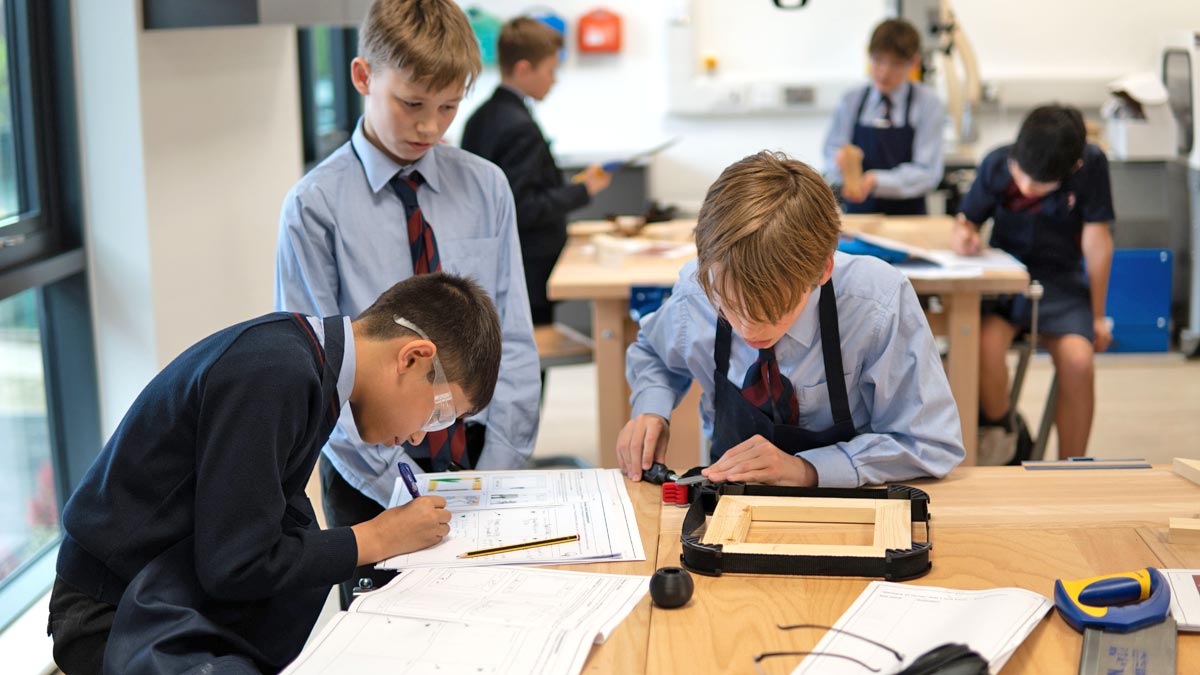
- Introduction to woodworking through several projects.
Design and Technology will prepare pupils to participate confidently and successfully in an increasingly technological world, as pupils gain awareness and learn from many wider influences on Design and Technology including historical, cultural, environmental and economic factors.
Art & Design
Head of Department: Mrs Felicity Sanders
Overview
Responding to the collaboration of Art and Mathematics, students will begin to broaden their knowledge and understanding of how both subjects are fundamentally intertwined. Pupils develop appreciation for the recording of the creative process through the use of a sketchbook. In-depth critical and contextual research will also form a fundamental part of the work undertaken, as pupils learn to draw inspiration for their work from an initial starting point. The discipline of drawing underpins all work and will continue to be taught explicitly throughout the year.
Artists’ works studied:
Pupils will develop classwork initiated by the optical illusions of Bridget Riley, appreciating how mathematics can be utilised in the formation of a composition. The contemporary paper engineering of Matt Shlian provides pupils with the opportunity to develop their work into 3-dimensions. The study of Islamic tiling promotes improved understanding of the process of tessellation. The unusual architectural work of Frank Gehry supports investigative play with small-scale building materials.
Media processes and techniques explored:
- Mixed media application
- Photography
- Digital design
- Paper engineering
- Acrylic painting
- Pen control
- Continuous line drawing/Observational drawing in pencil
Further Information and Assessment:
The Art department is well stocked with a creative library of books. Pupils are invited to use free online software such as Photopea to work digitally, and record their creative processes in a sketchbook throughout the year.
It is paramount to the development of the pupils’ learning that their sketchbook is cared for as this will travel home and back for the completion of Art homework tasks.
Pupils can track the development of their skills through their class sketchbook, supported by success criteria linked to the GCSE assessment matrix. Homework is undertaken each week to extend learning and will be posted when necessary on the VLE. Pupils can attend a Senior Art Club after school on a Monday as well as homework support one lunchtime a week. Pupils are strongly encouraged to visit Art Galleries to experience real Art up-close, talk about artforms and movements beyond those provided, and contribute personal artwork to the Student Gallery. Submissions for external Art competitions is encouraged.
Sport & Physical Education
Director of Sport: Mr Paul Hodgson
Within the core Physical Education programme, we continue the ethos of the subject, which is a wide and varied programme to benefit the pastoral well-being, physical health and sporting enjoyment of all pupils. We aim to reinforce prior learning in various activities by building on techniques and skills already developed and harnessed. Through the Games programme, pupils will be placed in similar ability teams in our major sports of Football, Rugby, Hockey and Cricket and compete against local schools. An option to experience the Rowing programme is also available for Year 7 pupils. There is an emphasis placed on good technical and tactical awareness during both Physical Education and Games lessons. Pupils will have the opportunity to interpret the laws of games and officiate in training matches whilst also learning the value of quality practice, training for specific sporting activities and setting long-term goals. With Year 7 Games being combined with Year 8, the culture and environment allow for increased peer-to-peer learning.
Pupils will take part in the following activities:
- Football (option)
- Multi-Sports (option)
- Rowing (option)
- Rugby (option)
- Cricket (option)
- Tennis
- Athletics
- Squash
- Hockey
- Golf
- Swimming
- Water Polo
- Table Tennis
- Badminton
Games: Wednesday and Friday
PE: Monday
After-school training: Monday
Scholarship & Performance Session: Tuesday before school
Swim Squad: Tuesday after school
Enriched Curriculum
Year 7 pupils have the opportunity to enjoy an “Enriched Curriculum”. The fundamental aim is for students to benefit from a broad education rather than having them focus on a narrow curriculum too soon. We believe we have introduced a programme that will deliver a much richer educational experience. The pupils will continue to prepare for assessments in the traditional way, but they will also have the opportunity to explore new subjects without the pressure of homework or exams.
However, the work will be closely monitored and assessed by staff using various methods of formative assessment, and half-term grades for effort and achievement.
The most able will also have the opportunity to undertake the Renaissance Challenge, which provides an opportunity to explore a number of disciplines in a depth that goes beyond the curriculum.